Showing posts with label Guns. Show all posts

Monday, January 28, 2013

Mission: Impossible – “Encore”


Season 6, Episode 2
Original Airdate: September 25, 1971
Writer: Harold Livingston
Director: Paul Krasny
Executive Producer: Bruce Geller
Cast: Peter Graves, Lynda Day George, William Shatner

I had never seen an episode of “Mission: Impossible” before this one. So I have no idea if “Encore” is a good representation of the rest of the series, but I really hope it is. Everything about it is legitimately insane, and yet the story is told with such style and conviction that, in its own weird way, it’s pretty close to perfect.

We begin with IMF (a super-secret government branch where all the agents have really awesome hair) team leader Jim Phelps (Peter Graves) getting his assignment of the week: to ascertain a confession and evidence against a murderer/mobster/all-around-evil-guy Thomas Kroll (Captain James T. Kirk…er…William Shatner). Kroll is in his 60s and just exploded a hospital where a little ‘ole lady was about to snitch on him, so we know he’s bad to the bone.

So IMF decides to (wait for it) make Kroll believe he has traveled back in time to save some humpback whales to 1937, the date he first met the woman he would ultimately kill in that hospital.

Yes, you read that right.

Okay, let’s break this down for a minute, shall we? They drug Kroll with a hot towel and kidnap him and give him a makeover. How can they make a 60-something guy with a limp appear to be in his 30s again, you ask? Well, they cover his face with wax and other magical elements and shoot his bad leg with a drug that will take away his limp. Phelps has rented out a film backlot and meticulously recreated at least two blocks from Kroll’s old neighborhood, right down to the buttermilk in his icebox. Oh, and I should mention that all of this appears to have been done in about 24 hours.

Like I said, this is nuts. And it would be completely laughable if it wasn’t done with complete conviction from everyone involved. Also, the viewer has to take a huge leap of faith, but as far as I’m concerned, I don’t want to watch a show called “Mission: Impossible” without muttering “that’s impossible!” to myself at least twice in a given episode. And even though the premise is…uh…farfetched, writer Ron Livingston creates some really smart complications among the impossible leaps. For example, the magic face wax and leg drug will only work for six hours.  And Kroll doesn’t act stupidly for a man in his situation. He scrubs his face thoroughly to ensure there’s no makeup to make him look younger. He rushes to a window when he hears a plane overhead (It’s a 1930s plane Phelps had fly over to help with the cover. These guys think of everything). More than that, above and beyond the time-travel trick, what we are witness to is a very elaborate mind game – almost a game of chess between a mostly unseen Phelps (who only interacts with Kroll once) and Kroll’s better instincts.

Yes, there are a thousand different ways this story is implausible and also a thousand ways that Kroll could make the team. I don’t care, because while the episode is playing, it’s all too much fun. Livingston actually takes more time that one would expect at turning Kroll into a legitimate character. Of course any 60-something guy magically back in the body of a 30-something-year-old would immediately want to chase some tail, and that’s what Kroll does, taking the “woman” he will eventually kill to a movie and making none-too-subtle remarks about wanting to get with her. That’s just creepy on so many levels.
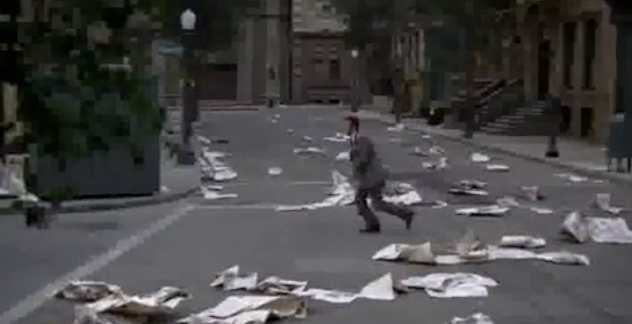
“Encore’s” director, Paul Krasny, keeps things seeming much bigger than they really are. For most of the episode we are in cramped, period sets that Krasny and his director of photography look rich and lush. It really feels like a movie more than an episode of television, never moreso than at the climax:

Kroll has just inadvertently given up the evidence, and suddenly everyone around him seems to evaporate.  Everyone has been pulled out, you see. One would also expect cops would be storming in, but go with it. Kroll wanders out into the period street, so bustling with life just moments prior, and it is now empty and abandoned. Kroll begins running, searching, and as he does so we see the ink put in his hair to shade it run down his cheeks. His wax begins to loosen. His limp returns. But he keeps running…until he runs all the way off the set and onto another one on the backlot: an street from classic shoot-‘em-up Westerns. It’s a wonderful, metaphorical image to end our story. Indeed, we don’t see Phelps apprehending our villain or even anything close to that. Instead, we see Kroll’s second in command, a man in his 60’s like Kroll, approach him – a reminder of who he really is and a mirror image Kroll does not want to look at. That is more of a defeat for him than being hauled off in handcuffs. And also, from the writing to direction, beautifully realized.

Back when I wrote about “Battlestar: Galactica” I noted how awesome it was that they share a sneak preview of what’s to come in the episode, and here I was just as excited to see the same in the opening credits. The show’s iconic theme music plays as we are shown tiny snapshots of exciting moments in the episode to come. Yes, setting Lalo Schifrin’s music against anything, even “Heaven’s Gate,” would make what we are seeing the most exciting action film ever made, and I think that’s the point. It jazzes up the viewer and ensures that he or she will be back and ready for more just as soon as the commercial break is over.

I’m surprised it’s taken me this long to watch the original “Mission: Impossible” television show. I’m a huge admirer of the film series, and now have set my DVR to tape the show’s nightly airing. From glancing at several articles, it appears that “Encore’s” craziness is the exception in the series, not the rule. But even if the show remains (relatively) grounded throughout the rest of its run, that won’t mean I love it any less. I can’t help but love the smoke-and-mirrors game it plays with its viewers and villains every week…and that theme song will never get old.

“Encore” is available on DVD and YouTube.


Saturday, December 22, 2012

The Outer Limits - "Demon With a Glass Hand"

Season 2, Episode 5
Original Airdate: October 17, 1964
Writer: Harlan Ellison
Director: Byron Haskin
Producer: Ben Brady, Leslie Stevens
Cast: Robert Culp, Arline Martel

“Demon With a Glass Hand” is a wonderful, complex science fiction story hidden underneath a beautifully shot film noir. It was “Blade Runner” long before that huge Geisha appeared on the skyscraper…and has better voice-over to boot. Writer Harlan Ellison sued the studio behind “TheTerminator” for plagiarizing his other (lesser) “Outer Limits” episode “Soldier” in a move that, to this writer, seems like quite a stretch. But though the mythology here is much different than “Blade Runner,” it’s impossible to not see all the inspirations, from the emotionless hero to the final twist.

Despite my obsession with all things “Twilight Zone” and love for anthology series in general, I’ve never before watched “The Outer Limits,” despite having the original series on DVD for a few years now. After finally digging in and watching several of the most popular episodes (“The Zanti Misfits,” “The Chameleon” and “Soldier,” among others), I was very much let down. Despite gorgeous cinematography and some good acting, the one-hour format stretched most of these science-fiction stories to their breaking point, despite very good ideas at their core. When half of your episodes feel like filler, you have a problem – the same one that “The Twilight Zone” dealt with when it expanded to an hour in its fourth season.

That’s one of the reasons why “Demon With a Glass Hand” (whose name doesn’t really make sense in retrospect) feels like such a breath of fresh air. Instead of filler scenes placed upon other filler scenes, writer Ellison provides us with an ever-changing Rubik’s cube of mythology, often so dense that the viewer is playing catch-up. It begins with a man named Trent (Robert Culp, purposely wooden) lost in modern times with a partially-constructed glass hand and several alien killers on his tail who are recognizable because they wear panty hose (not kidding) on their faces. Trent has no idea who he is, only that he supposed to be humanity’s savior, and he must retrieve the three missing fingers for the glass hand to understand entirely what has happened to him and what he must do to save the humanity of the future. And trust me, I’m just scratching the surface here. There’s more, lots more.

The first ten minutes of the episode feel like an exposition bomb has gone off. First Trent gets a boatload of information from the mysterious panty hose aliens, then more exposition from his hand, then he meets up with a woman and explains even more to her. It’s difficult to keep everything straight and would usually signal very clunky writing, but because Trent is almost as confused as we are, the exposition dump actually works to the episode’s advantage. We go along for the ride, waiting for pay-offs to mysteries we only half understood to begin with, and when those pay-offs come they are both surprising and fascinating.

Everything speeds up once Trent gets to an office building where the aliens are headquartered. Though director Byron Haskin and his fantastic cinematographer Kenneth Peach employed the shadows of noir from the first frame of the episode, the noir look goes into overdrive in this beautifully rendered building, filled with fantastic architecture and maze-like hallways. It reminds me a lot of the office in Billy Wilder’s “Double Indemnity,” and I wasn’t surprised to read that Ridley Scott used the sameplace to film the third act of “Blade Runner” (there’s that movie again).

Trent runs into a woman named Consuelo (Arline Martel) who was working late and turns her into his companion, not by choice, but because the aliens have put an invisible barrier around the building. Together they move up the several floors of the building, ultimately to the roof, before Trent descends back into the danger below as Dante did into the inferno.

"Cowabunga, dude!"
Many of the more sci-fi elements of the episode are almost laughable, and this is true of the show in general. The killer ants in “Zanti Misfits” had cute teddy bear faces and were obviously horrible models swung on strings during the final siege. The aquatic monster in “Tourist Attraction” would have fit better as one of Ariel’s pets in “The Little Mermaid” than on “The Outer Limits.” Here Trent’s glass hand isn’t the most impressive prop (and, for a long period of time, is stuck in a “Cowabunga, dude!” position). The aliens all wear a big necklace that, when torn off of them kills them and sends their bodies back to the future – and yet none of them think they might be safer if they just tuck it into their shirt. And I did mention the panty-hose faces, right?

I’m willing to forgive many of these in part because of the show’s budget, time period and that, yes, “The Twilight Zone” had many shoddy effects too. But what really saves the more eye-rolling parts of the production are the film noir elements. Even the most laughable costumes look awesome when shot in shadow, and the kookiest villains look menacing when you can barely get a good look at them. It’s inspired that Trent and the aliens use guns, actual guns, to do their battle. Ellison apparently was horribly unhappy with that decision, but seriously, what adaptation of his work has he not all-but-disowned after the fact, and here the guns bring a unique level of urgency to the storytelling missing from other science fiction (the guns used here are infinitely scarier than, say, the ray gun from Ellison’s other episode “Soldier”).

The twist at the end of the episode is a genuinely surprising one that hits the viewer on both an emotional and intellectual level, and fits perfectly in the world of noir. It is also darker and self-defeating than one would expect from an anthology, a trait that seems to be repeated throughout almost every “The Outer Limits” episode I’ve seen. Humanity always sucks, things never get better, and our heroes must consistently suffer for little reward. It’s a very dire notion for stories whose imagination is supposed to reach from the inner mind to the outer limits, and perhaps that’s another reason why I haven’t become fully invested in the series. The ending worked beautifully here, that’s for sure, but in the other episodes I’ve seen it just felt tacked-on, as if it was trying to prove a point. Ah well, the show still has many great qualities and I’m looking forward to diving into the remainder of the episodes. I will say one thing about it: the opening credits are much cooler than any of those in “The Twilight Zone’s” history. So that’s, uh, something.

“Demon With a Glass Hand” is available on DVD, AmazonInstant Video, Hulu, iTunes and YouTube.

Sunday, August 12, 2012

Alias - "Phase One"

Season Two, Episode 13
Original Airdate: January 26, 2003
Writer: J.J. Abrams
Director: Jack Bender
Executive Producer: J.J. Abrams, Ken Olin
Cast: Jennifer Garner, Michael Vartan, Victor Garber, Carl Lumbly

When television shows reinvent themselves, it is usually because producers or the network think that the storytelling has gone off course or stagnated…or because a popular actor is leaving his or her role. You rarely see it done on a “healthy” show. Sure, shows like “24” claim to hit the reset button every season, but then a mole always shows up in CTU and Jack ends up in handcuffs again. Off the top of my head I can think of the “Two Fathers/One Son” episodes of “The X-Files” that brought to a head six years of complex mythology, Roseanne’s family winning the lottery and the complete creative makeover of “The Practice” in its final season before it transformed into “Boston Legal.” And then there is “Phase One,” which feels for most of its running time like a series finale before upending our expectations and setting the stage for a completely revamped version of “Alias.” The show would pull a similar change-up at the end of this season and several other times during its five-season run, but “Phase One” remains the best of the bunch and one of the most engaging episodes of adventure television ever produced.

Up until this point, the series focused on secret agent Sidney Bristow (Jennifer Garner), who believed she was working for the CIA until they killed her fiancé. She then realized she was working for a terrorist cell called SD-6 and became a double agent, working with the real CIA to take down SD-6 with her father Jack (Victor Garber), who was also a double agent. Also, Sidney’s mom had shown up and there was all this stuff about a dude named Rambaldi and a floating red ball filled with water and Francie (Merrin Dungey) had just opened a restaurant. Phew.

When you consider the circumstances surrounding the production of this episode, it’s a miracle it’s even comprehensible—let alone awesome. You see, “Alias” was chosen to be the show that immediately followed the Super Bowl. This was an opportunity for showrunner J.J. Abrams (who also wrote the episode) to attract a lot of new eyeballs, but getting those viewers up to speed on the complex mythology (see above) and who is who was not exactly an easy task. Instead of just making the episode a jumping-on point, which was the logical thing to do, Abrams instead decided to get viewers up to speed on the mythology…and then blow it up by the end. All in a 42 minute running time.

Shockingly, Abrams pulled it off with a lot of style and still manages to insert several beautiful character moments that had become a hallmark of the series. Turns out the guy is pretty good at this kind of thing—think of his reboot/sequel “Star Trek,” (which was co-written by “Alias” writers Alex Kurtzman and Roberto Orci), which boiled down decades of “Star Trek” mythology to its essentials while still telling a coherent, enjoyable story that could attract new viewers.

The black one.
Apparently eager to ensure male viewers would stick around, the episode opens with Sidney on a private plane strutting her stuff in black underwear…then re-strutting it in red underwear. The camera lingers on her assets in an almost exploitative manner (while AC/DC plays in the background, no less!), but Abrams and his director Jack Bender almost immediately upend this male-fantasy by having Sidney kicking the ass of the guy oogling her (“What was wrong with the black one!?” she hisses as she strangles him, before continuing, “You think it’s comfortable wearing clothes like this?”). There’s a fight scene that leaves Sidney in mortal jeopardy and then we flash back one day earlier.


The red one.
Even though series supervillain Arvin Sloan (Ron Rifkin) is mostly M.I.A. here, Abrams introduces a new, wonderful baddie named Geiger, played by Rutger Hauer, who has been inserted as acting director of Sidney’s branch of SD-6. As if having The Hitcher in the episode wasn’t enough, there’s also a cameo by The Tall Man (Angus Scrimm) as a computer expert. “Alias” was a show unafraid to showcase its geek roots, and also had small roles for such greats as Quentin Tarantino and David Chronenberg.

Admittedly, the plot centers on a deus ex machina. All of the information needed to take down SD-6 just happens to be aboard the plane we see Sidney fighting in during the opening sequence. But Abrams does a fantastic job of dressing up the deus ex machina so well you barely even notice. First there is the aforementioned playing with time, then the ticking-time-bomb aspect to the information that can only be solved by Sidney admitting everything to her best friend in SD-6, Dixon (Carl Lumbly), because he has to send a confirmation code to the CIA in order for them to take down the enemy. Got all that?

The scene where Sidney tells Dixon that his entire life is a lie hits you like a punch to the gut, and rightfully so. In the pilot, we weren’t as emotionally invested in Sidney’s realization because we barely knew her as a character, but here the weight of the revelation is given time to sink in. Abrams even allows time for Dixon, convinced he may die that day, to call his wife to tell her he loves her. The emotional stakes are much higher than just Dixon’s arc, though: Jack is discovered to be a double agent, kidnapped and tortured at length by Hauer’s character to see who he is working for. There’s another beautifully written small scene where, in the midst of the torture, Jack tells Geiger that they actually had dinner together one night, and they laugh as they share memories of the moment. It’s completely throwaway but humanizes Geiger (who until this point has come off as oily as Lex Luthor) and makes us root for Jack all the more.

And then there’s the action. The episode’s centerpiece is indeed the plane sequence, and when it’s revisited halfway through, the tension escalates until Sidney is forced to blow out the side of the plane, cause it to crash and manages to jump out of it with a parachute at the last moment. The set-piece looks and feels very expensive (the CGI work is feature-worthy), and seems like a sly tip-of-the-hat to the climax of “Goldfinger.”

Oh, and Sidney also makes out with Vaughan (Michael Vartan).

Oh, and Francie is killed and replaced with an evil identical version.

That’s one hell of a lot for one episode, and most of what Abrams does is directly against everything television writers are taught. You are never supposed to change the premise of the show so much that it becomes unrecognizable. You are never supposed to get your will-they-won’t-they couple together before the series finale. And this especially should not happen only halfway through the season. But if all this is so wrong, then why does it feel so right?

“Phase One” is available on the second season DVD of “Alias” and on Youtube. Sorry, no Hulu or iTunes this time.

Saturday, July 7, 2012

Alfred Hitchcock Presents : “Bang! You’re Dead”


Season 7, Episode 2

Original Airdate: October 17, 1962

Writer: Harold Swanton (teleplay), Margery Vosper (story)
Director: Alfred Hitchcock
Producer: Joan Harrison
Cast: Bill Mumy, Steve Dunne, Biff Elliott, Lucy Prentiss

Though “Alfred Hitchcock Presents” often toyed with tone and allowed Hitchcock’s trademark dark humor to infect its best episodes, “Bang! You’re Dead” represents the darkest, most blatantly suspenseful the series ever became. There is nary a joke or wink at the audience to be found – just tension building on established tension until it becomes almost unbearable.

The premise alone is enough to stand up the hairs on the back of your neck. A young boy (Bill Mumy, who also sent everyone to the cornfield in the classic “The Twilight Zone” episode "It's A Good Life") gets ahold of a real gun and, thinking it is a toy, loads it and heads into town for a good old fashioned shoot ‘em up.

Logic immediately argues that the kid won’t actually kill anyone. After all, this is an television episode from 1962…and did I mention it’s a kid? But you immediately begin questioning yourself as soon as the episode begins. Like every other episode of the series, Hitchcock appears and makes a joke or two of introduction. But then, surprisingly, he becomes very solemn and serious. He states the following:


“Despite the fact that this has been introduced with my usual flippancy, it concerns a very serious subject. I would be doing it a disservice if I led you to regard it lightly.”
Uh oh. What are you trying to tell us, Hitch?

Richie (Mumy) is the child in question. His uncle (Steve Dunne) has just returned home from Africa with a wooden tribal mask (the African mask represents a metaphor for their alleged “savagery” (“I had to sleep with a gun under my pillow every night,” the uncle says) contrasted with America’s young generation’s obsession with killing one another) and vague promises of a “present” for Richie. The boy is told to unpack his uncle’s suitcases and finds a swell looking gun right next to a box of bullets. Richie shoves a bunch of bullets in his pocket, exchanges his plastic gun for the real one and starts pointing it at people.
Hitchcock directed the episode, and in the early moments when Richie first has the gun, Hitchcock frames his shots so that we are behind the child, looking over his shoulder. In essence, we have become the boy. Since we have already been thrown by Hitchcock’s seriousness in his introduction, we also wonder about the pacing of the story. Realistically, the gun could go off at any point and the rest of the episode could involve the aftermath. In other words, the tension is palpable from the moment Richie puts the first bullet in the gun.
If that wasn’t enough tension, the episode’s writer, Harold Swanton, employs an ingenious way to keep upping the stakes as the episode progresses. At first, Richie only puts one bullet in the gun, and every time he gets ready to fire he spins the chamber. Yup, it turns into a sick variation on Russian Roulette. And every now and then Richie will add another bullet. And another. Until the gun is completely loaded.

We have a classic example of Hitchcock’s “bomb under the table.” In a conversation with Francois Truffaut, Hitchcock beautifully explained the difference between surprise and suspense thusly:


“We are now having a very innocent little chat. Let's suppose that there is a bomb underneath this table between us. Nothing happens, and then all of a sudden, ‘Boom!’ There is an explosion. The public is surprised, but prior to this surprise, it has seen an absolutely ordinary scene, of no special consequence. Now, let us take a suspense situation. The bomb is underneath the table and the public knows it, probably because they have seen the anarchist place it there. The public is aware the bomb is going to explode at one o'clock and there is a clock in the decor. The public can see that it is a quarter to one. In these conditions, the same innocuous conversation becomes fascinating because the public is participating in the scene. The audience is longing to warn the characters on the screen: ‘You shouldn't be talking about such trivial matters. There is a bomb beneath you and it is about to explode!’

“In the first case we have given the public fifteen seconds of surprise at the moment of the explosion. In the second we have provided them with fifteen minutes of suspense. The conclusion is that, whenever possible, the public must be informed. Except when the surprise is a twist, that is, when the unexpected ending is, in itself, the highlight of the story.”

Here, the child is the bomb.

I’m surprised that, considering the circumstances, Hitchcock is as restrained as he is concerning false alarms. There’s only one moment where we think the gun has gone off when it has not – when a car backfires in a supermarket parking lot.
By the time Richie returns home, his parents and uncle have left to frantically search for him. The only person there is the housekeeper, who arrived too late to know Richie has a (now fully-loaded) gun. Richie wants her to play. She’s busy. And we, as viewers, sense that the half-hour is almost up. Something has to go down soon.

Hitchcock moves the camera back to the boy’s perspective as he aims at the housekeeper. The moment is intentionally evocative of the climax of his film “Spellbound,” where the villain pointed his gun at Ingrid Bergman before committing suicide (if you watch the video, note the one frame of red used in the black-and-white film to represent the villain’s death. Awesome, right?), and works here even better. The gun finally goes off and misses the maid by just a few inches, but the fact that the kid is no longer going to be playing with guns is little comfort.

“Alfred Hitchcock Presents” is usually mentioned in the same breath as “The Twilight Zone” and “Thriller” as one of the best anthologies ever created, but that is mostly on the strength of the episodes Hitchcock personally directed (usually three or four a season). The truth is that the quality and tone of the show varied greatly from episode to episode (yes, that’s a given with anthologies, but it’s even more pronounced than usual here), with many episodes seeming twice their length and containing storylines so light they barely exist. For example, one episode hinged entirely on a woman getting trapped in a hotel room with a sleeping man. Yes, that’s all. The most well-regarded episode seems to be “Lamb to the Slaughter,” where Barbara Bel Geddes kills her husband with a leg of lamb then bakes it for the police who are investigating. But for me, the best episodes are the ones that go for the jugular from the get-go, like this episode or “Breakdown,” where Joseph Cotton is mistaken for dead after a traffic accident.

“Bang! You’re Dead” represents an excellent example of how to keep suspense going incessantly for an entire episode. I can’t think of another episode of television that manipulated me with its suspense and kept me on the edge of my seat like this.

“Alfred Hitchcock Presents: Season Seven” is (shockingly) not yet available on DVD. However, it is available on Youtube for your viewing pleasure.