Showing posts with label Thriller. Show all posts

Monday, March 4, 2013

Thriller - "Pigeons From Hell"


Season 1, Episode 36
Original Airdate: June 6, 1961
Writer: John Kneubuhl (adaptation), Robert E. Howard (original story)
Director: John Newland
Producers: William Frye, Maxwell Shane
Cast: Brandon De Wilde, Crahan Denton, David Whorf, Boris Karloff

“Pigeons From Hell” is a masterpiece of slow-burn horror. At first glance, its creators seem content to embrace all the usual trappings that are trotted out to achieve cheap, impact-less scares. But instead of the cheap scares, we are instead treated to slow tension building over the course of the hour, deliberately paced to get under the viewer’s skin and linger there.

Tell me if you’ve heard this one before: Two brothers (Brandon De Wilde and David Whorf) find their car broken down on an abandoned highway in the middle of nowhere. They come upon a nearby abandoned mansion… and then the horrors begin to happen. But instead of a bunch of scares straight out of the Universal B-horrors of the 1940s, writer John Kneubuhl and director John Newland aim to create the best movie Val Lewton never produced. It is an adaptation of a great short story by Robert E. Howard (a writer who inadvertently was the cause of Arnold Schwarzenegger’s career by creating “Conan the Barbarian,” but don’t hold that against him), and in his adaptation Kneubuhl makes two distinct but very smart changes.

In the original story the young men are just friends, but here they are brothers. When Whorf’s character gets an ax to the skull, there is much more emotional resonance for both the audience and De Wilde’s Timothy. The original story worked fine without it, but here it gives the death extra significance, especially considering we only have five minutes with the characters before one is murdered.

Second, the short story takes place over the course of two or three days and nights, but Kneubuhl condenses the story to a single, endless night of horrors. That way the atmosphere is relentless – the characters cannot escape the dark and neither can we.

The most overt horror in the episode comes early: The aforementioned ax murder. While his brother sleeps, Whorf’s Johnny is drawn up the stairs of the deserted mansion by ghostly singing. When Timothy goes searching, he finds Johnny’s skull cracked in two. But that doesn’t make Johnny any less mobile – his brains still bleeding all over, Johnny chases Timothy out of the mansion, waving about the ax that was used to kill him. Despite the grisliness of what I have just described, the scene is played almost entirely by suggestion. While Johnny stalks Timothy in the hallway, we never actually see the split skull or the brains… all we see are drops of blood streaming down the front of his face. Everything else is hidden by the shadows.

Timothy manages to make it a few hundred yards away from the mansion before passing out. He is brought to the nearest Sheriff (Crahan Denton) by a town hick, and when the Sheriff decides to take the boy back to the mansion to investigate, we get the single inadvertently funny moment of the episode: The hick busts out of the house they are in and rushes off into the nearby woods like the Roadrunner escaping the Coyote. De Wilde, who many will remember for saying “Shane!” a thousand times in the film classic, also has the task of attempting to explain what happened to him in the mansion while being overcome with grief for his brother, and though his line readings might come off as hackneyed in another film, his innocent looks and inability to properly articulate himself actually works in favor of the character.

The Sheriff takes Timothy back to the mansion to investigate, and instead of a bunch of boo-scares and chains rattling, Newland provides viewers with a single, indelible image. Every time the duo enter the room where Johnny died, their kerosene lantern will not stay lit. The moment they exit the room, it comes back on. Any fan of a good horror movie knows the darkness is much scarier than seeing what is in the darkness, and that is never more obvious than here. Also, because there are no silly noises or faux-climaxes in the sequence, the viewer is consistently on the edge of his seat. There is no end to the tension until they leave the house – the threat of something bad happening ensuring the viewer cannot relax.

The atmosphere is only aided by the black-and-white cinematography, shot by Lionel Lindon (who also shot the incredible “The Manchurian Candidate” and the minor noir classics “Whirlpool” and “The Blue Dahlia”). I doubt there’s a shot in the film where everything in a given set is fully lit. Lindon uses the shadows to play with our expectations of terror, especially considering a character says early that the swampland is crawling with snakes. The lighting also makes some old-man makeup that would doubtless look hackneyed in color into something downright creepy.

Kneubuhl and Newland approach the episode’s climax with the same slow-burn mentality, refusing to ratchet up the pace for no good reason. As a result, Timothy’s slow, zombie-like walk up that decrepit staircase toward his destiny becomes excruciatingly suspenseful.

It's all about those eyebrows.
I got the “Thriller” boxed set for Christmas this year and have been consistently surprised at the quality of the episodes. It’s the only hourlong anthology series I’ve seen thus far that makes good use of its entire running time (unfortunately, “The Outer Limits” often feels like a half-hour show stretched to its breaking point to fill its hour) on a regular basis. I’ve watched about half the series (the first season is 37 episodes, so it’s not like I’m being lazy) and find that even the lesser episodes are still of legitimate quality, and Jerry Goldsmith’s musical scores are feature-film worthy, even eclipsing Bernard Herrmann’s scores for “The Twilight Zone.” The show pays homage to the Universal classic horrors of the 30s, especially with its use of host Boris Karloff (whose eyebrows here are epic, matched only perhaps by Larry Hagman’s in the “Dallas” reboot), but takes most of its inspiration from Lewton’s horror films of the 40s. Still, every now and then you can see the viciousness of the 50s Hammer films sneaking in. Since I love all those eras of fright, I feel like a kid in a candy shop every time I insert a new disc. “Pigeons From Hell” is my favorite, but I could have easily chosen “The Grim Reaper,” “Parasite Mansion,” “Late Date” “The Hungry Glass” or “The Purple Room”…and that’s just from the first season. It’s such a shame this show doesn’t exist in the public consciousness in the same way “The Twilight Zone” or “Alfred Hitchcock Presents” does, because it certainly deserves to be.

“Pigeons From Hell” is available on DVD and YouTube.

Monday, February 25, 2013

Southland - "Graduation Day"


Season 3, Episode 10
Original Airdate: March 8, 2011
Writers: John Wells (teleplay), Heather Zuhlke (story)
Director: Christopher Chulack
Executive Producers: Christopher Chulack, John Wells
Cast: Ben McKenzie, Regina King, Shawn Hatosy, Michael Cudlitz

For a show whose survival has been nothing short of miraculous and whose storytelling is consistently brilliant, “Southland” never seems to get the respect it deserves. Everyone I’ve recommended the show to doesn’t seem to know it exists or thinks its been long-cancelled, and yet when they actually watch an episode they end up addicted. And while I came close to choosing the nearly-flawless pilot for this article, “Graduation Day” represents the show at its creative peak, and part of what makes this episode special is that it should not logically exist.

The premise of “Southland” is as simple as they come – it follows the day-to-day lives of a handful of Los Angeles police officers and detectives. No huge meta twist, no quirky detective protagonist…just real people trying to stay above water while doing one of the most emotionally taxing, physically dangerous jobs on the planet. It premiered on NBC as a midseason replacement to decent ratings and was renewed for a second season shortly thereafter.

Then the great NBC Jay Leno experiment came into play.

For those unfamiliar, for a season NBC wiped all original programming from their 10 o’clock hour and replaced it with a Jay Leno talk show that premiered to huge ratings but then quickly floundered. Because of “Southland’s” dark content, NBC’s executives allegedly became very uncomfortable with airing it at 9 p.m. and cancelled it before it even had a chance to premier, with six episodes already filmed.

TNT, a network known more for “The Closer” than for gritty, realistic drama, swooped in and agreed to air the six unaired season two episodes. Then, miracle of miracles, the network picked it up for a third season of ten episodes with a much-reduced budget…and the results are some of the best television I have ever seen. It’s not often that a show has a “perfect” season, and even now I can count them on a single hand…but, to me, the season is just about as perfect as they come. The show seemed to flourish under the budget cuts, taking more chances and finding inventive (and often heartbreaking) ways to trim its cast. The storytelling was more honest and streamlined – and now the show is in the middle of its fifth season. All with a fraction of the critical acclaim lavished on shows like “Girls” or “Boardwalk Empire.”

But back to “Graduation Day” which, despite being the third season finale, is only the 23rd episode of the series. The brilliant John Wells (who helped to craft such masterworks as “The West Wing” and “E.R.”) wrote the script based off a story by Heather Zuhlke, and together they paid off storylines that had legitimately been building since the first episode of the series. I’m guessing that they went into the episode assuming that it would be a series finale, which is why there is an added sense of urgency to almost every scene.

The theme of the hour, underlined by its title, is one of transitions for every cast member. Ben (Ben McKenzie) is graduating from boot cop. Cooper (Michael Cudlitz) finally must face his painkiller addiction head on. Sammy (Shawn Hatosy) finally catches the scum who murdered his partner and welcomes his son into the world. Chickie (Arija Bareikis) is moving on from her partnership with Dewey (C. Thomas Howell), who doesn’t know how to deal with it. And Lydia (Regina King) explodes the finally stable relationship she has with her partner.

As with any episode of “Southland,” it’s all about the moment-to-moment encounters these officers have and how those small beats build up to a cohesive whole. A career. A life. In a scene that could easily have come across as throwaway, Ben and Cooper are called to a house where a mother is livid that her husband allowed a gang symbol to be tattooed on their six-year-old son. The scene plays almost comically at first, but then we see the young boy point his finger at Cooper repeatedly and pretend to be shooting him. And suddenly, our hearts break. We understand the struggle they go through and recognize how much these cops must feel like they are punching water on a day-to-day basis.

Another beautifully realized moment: Sammy learns that there is a warrant out against the man he knows killed his partner, though not for the murder. The thug is involved in a shootout and Sammy races to the thug just in time to see him bleeding to death. Instead of comforting him or walking away, Sammy leans into the guy’s face and repeats his partner’s name, Nate Moretta, over and over until the man is dead. It’s immensely powerful and a fantastic way to climax the main arc of the season, but one can’t help but be a little horrified by it. In other words, it’s great drama.

As if that wasn’t enough, the centerpiece of the finale is a fantastic foot chase between Ben and a rapist/kidnapper, with the drug-addled Cooper far behind and barely able to walk, let alone lend support his partner. In fact, there’s a moment where Cooper is climbing over a fence and we see his entire body shift and crack before he falls that is one of the most cringe-inducing I’ve ever seen. The action moves to a series of rooftops that Jimmy Stewart should really avoid. Director Christopher Chulack (who directed many of “Southland’s” best hours) gives the sequence a great build and tension, never allowing the scope of the set-piece outmeasure the grittiness of its circumstances. There’s a down-and-dirty hand-to-hand fight between Ben and the rapist that is punctuated with a climax that left my jaw on the floor thanks to a really, Really, REALLY amazing stunt (the show’s only Emmy love comes from its stuntwork, which is always aces).

In all of its most important episodes, the writers find new shades and uses for the simple phrase “I’m a cop.” In the pilot Ben says it, in the second-season finale Chickie says it while arresting a cop-impersonator. Here the statement, so important and iconic to the series, it spoken by Cooper while he is volunteering for detox before he can have back surgery. He’s broken mentally and physically, but still a person. Still human. And that’s what “Southland” so perfectly portrays. Its characters are flawed, sometimes horrible, but ultimately good…and we can’t help but love them for it. This is a fantastic show, one whose reputation will certainly grow over time. Take my word for it; “Southland” is a modern classic…most people just don’t know it yet.

“Graduation Day” is available on iTunes and DVD.

Monday, January 28, 2013

Mission: Impossible – “Encore”


Season 6, Episode 2
Original Airdate: September 25, 1971
Writer: Harold Livingston
Director: Paul Krasny
Executive Producer: Bruce Geller
Cast: Peter Graves, Lynda Day George, William Shatner

I had never seen an episode of “Mission: Impossible” before this one. So I have no idea if “Encore” is a good representation of the rest of the series, but I really hope it is. Everything about it is legitimately insane, and yet the story is told with such style and conviction that, in its own weird way, it’s pretty close to perfect.

We begin with IMF (a super-secret government branch where all the agents have really awesome hair) team leader Jim Phelps (Peter Graves) getting his assignment of the week: to ascertain a confession and evidence against a murderer/mobster/all-around-evil-guy Thomas Kroll (Captain James T. Kirk…er…William Shatner). Kroll is in his 60s and just exploded a hospital where a little ‘ole lady was about to snitch on him, so we know he’s bad to the bone.

So IMF decides to (wait for it) make Kroll believe he has traveled back in time to save some humpback whales to 1937, the date he first met the woman he would ultimately kill in that hospital.

Yes, you read that right.

Okay, let’s break this down for a minute, shall we? They drug Kroll with a hot towel and kidnap him and give him a makeover. How can they make a 60-something guy with a limp appear to be in his 30s again, you ask? Well, they cover his face with wax and other magical elements and shoot his bad leg with a drug that will take away his limp. Phelps has rented out a film backlot and meticulously recreated at least two blocks from Kroll’s old neighborhood, right down to the buttermilk in his icebox. Oh, and I should mention that all of this appears to have been done in about 24 hours.

Like I said, this is nuts. And it would be completely laughable if it wasn’t done with complete conviction from everyone involved. Also, the viewer has to take a huge leap of faith, but as far as I’m concerned, I don’t want to watch a show called “Mission: Impossible” without muttering “that’s impossible!” to myself at least twice in a given episode. And even though the premise is…uh…farfetched, writer Ron Livingston creates some really smart complications among the impossible leaps. For example, the magic face wax and leg drug will only work for six hours.  And Kroll doesn’t act stupidly for a man in his situation. He scrubs his face thoroughly to ensure there’s no makeup to make him look younger. He rushes to a window when he hears a plane overhead (It’s a 1930s plane Phelps had fly over to help with the cover. These guys think of everything). More than that, above and beyond the time-travel trick, what we are witness to is a very elaborate mind game – almost a game of chess between a mostly unseen Phelps (who only interacts with Kroll once) and Kroll’s better instincts.

Yes, there are a thousand different ways this story is implausible and also a thousand ways that Kroll could make the team. I don’t care, because while the episode is playing, it’s all too much fun. Livingston actually takes more time that one would expect at turning Kroll into a legitimate character. Of course any 60-something guy magically back in the body of a 30-something-year-old would immediately want to chase some tail, and that’s what Kroll does, taking the “woman” he will eventually kill to a movie and making none-too-subtle remarks about wanting to get with her. That’s just creepy on so many levels.

“Encore’s” director, Paul Krasny, keeps things seeming much bigger than they really are. For most of the episode we are in cramped, period sets that Krasny and his director of photography look rich and lush. It really feels like a movie more than an episode of television, never moreso than at the climax:

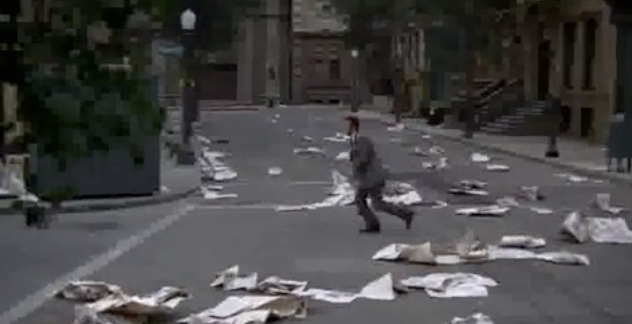
Kroll has just inadvertently given up the evidence, and suddenly everyone around him seems to evaporate.  Everyone has been pulled out, you see. One would also expect cops would be storming in, but go with it. Kroll wanders out into the period street, so bustling with life just moments prior, and it is now empty and abandoned. Kroll begins running, searching, and as he does so we see the ink put in his hair to shade it run down his cheeks. His wax begins to loosen. His limp returns. But he keeps running…until he runs all the way off the set and onto another one on the backlot: an street from classic shoot-‘em-up Westerns. It’s a wonderful, metaphorical image to end our story. Indeed, we don’t see Phelps apprehending our villain or even anything close to that. Instead, we see Kroll’s second in command, a man in his 60’s like Kroll, approach him – a reminder of who he really is and a mirror image Kroll does not want to look at. That is more of a defeat for him than being hauled off in handcuffs. And also, from the writing to direction, beautifully realized.

Back when I wrote about “Battlestar: Galactica” I noted how awesome it was that they share a sneak preview of what’s to come in the episode, and here I was just as excited to see the same in the opening credits. The show’s iconic theme music plays as we are shown tiny snapshots of exciting moments in the episode to come. Yes, setting Lalo Schifrin’s music against anything, even “Heaven’s Gate,” would make what we are seeing the most exciting action film ever made, and I think that’s the point. It jazzes up the viewer and ensures that he or she will be back and ready for more just as soon as the commercial break is over.

I’m surprised it’s taken me this long to watch the original “Mission: Impossible” television show. I’m a huge admirer of the film series, and now have set my DVR to tape the show’s nightly airing. From glancing at several articles, it appears that “Encore’s” craziness is the exception in the series, not the rule. But even if the show remains (relatively) grounded throughout the rest of its run, that won’t mean I love it any less. I can’t help but love the smoke-and-mirrors game it plays with its viewers and villains every week…and that theme song will never get old.

“Encore” is available on DVD and YouTube.


Route 66 – “Lizard’s Leg and Owlet’s Wing”


Season 3, Episode 6
Original Airdate: October 26, 1962
Writer: Stirling Silliphant
Director: Robert Gist
Producer: Mort Abrahams, Leo Davis
Cast: Martin Milner, George Maharis, Boris Karloff, Peter Lorre, Lon Chaney Jr.

“Lizard’s Leg and Owlet’s Wing” is a fantastic, wrapped present to fans of 1930s and 1940s horror classics. I hesitated for a while to write up an article about this episode because I don’t really think that it fits the definition of “great television” in the way the other shows I have written about here do. The writing here isn’t the best and it’s tonally different than the other “Route 66” installments I’ve seen. But that’s before you insert what I like to call the “awesomeness” factor at play here. I’m just a tad obsessed with those old classic horror movies I mentioned earlier, so to get to see Boris Karloff, Peter Lorre and Lon Chaney Jr. not only interact with one another, but don some of the most iconic film make-up of all time makes me happy in ways I can’t begin to articulate.

The episode opens with a young boy asleep in his bed when what appears to be a hunchback walks in. Turns out it’s just Lon Chaney Jr. (“The Wolf Man” himself, “The Son of Dracula”) wanting to tuck his grandson in, and he’s wearing his father’s get-up from the silent version of “The Hunchback of Notre Dame.” At this point I checked my DVR to make sure this was really “Route 66” and it told me it was. Then we cut to a three-way phone conversation between Chaney, Peter Lorre (perhaps history’s greatest character actor, but know for golden age of horror roles like “Mad Love”) and (cue the Angel chorus) Boris Karloff (“Frankenstein,” “Bride of Frankenstein,” “The Mummy,” “The Old Dark House,” “The Black Cat,” “Isle of the Dead” and so many others, but most horrifyingly the “Mr. Wong, Detective” series for Monogram). At this point I figured I must have accidentally DVR’ed the wrong show.  This must have been writer Stirling Silliphant’s idea for a tricky, surprising teaser, and fifty years later it still works like a charm. In fact, this type of fake-out teaser has been copied many times since in horror series – just think of the “Humbug” episode of “The X-Files.”

The plotlines for the episode are light as a feather and done with an ample amount of good dialogue. Tod (Martin Milner) and Buzz (George Maharis) get a gig at a fancy hotel outside Chicago. Karloff, Chaney and Lorre (playing themselves) have come to discuss a possible television series they would star in and argue about whether they should stick to the old ways (Universal horror) or go the new route (Hammer horror), and Tod must act as their liaison to the hotel…or something. Buzz is in charge of a women’s lib convention and immediately falls head over heels with one of the secretaries there, who is depressed after her boss left her for his fiancé. Seriously. Though the A and B stories couldn’t seem more dissimilar, Silliphant finds ingenious crossovers between them. To prove the old scares are still viable, Chaney dresses up in Wolf Man garb and causes every woman in sight to faint in horror, and Karloff has a surprisingly sweet scene with the depressed secretary where he gives her love advice.

The real attraction here is getting to see the three legends interact with one another, with “the normal people” and dress up as the old favorites. Also, a quick shout-out to Lorre’s suitcase, which is alligator skin, has an actual alligator head as its handle (I’m not kidding) and almost steals the show. It’s always a thrill to see Karloff play a nice guy since his image is so synonymous with grotesquery, and here, playing a version of himself, he has a surprising amount of comedic timing, landing every punchline thrown at him. Lorre had long perfected his depressed-annoyed persona and seems to be having a horrible (meaning wonderful) time onscreen. Chaney is rarely out of make-up here, but I’m sad to report that when he is, he looks absolutely miserable. He can barely land any line other than grunting and seems to have trouble doing, well, anything. I have no idea whether it was his rumored alcoholism or what, but someone definitely needed to give him a Red Bull or something.

Chaney does do a decent job seeming very tortured while dressed up as the aforementioned Hunchback, the Mummy (though Karloff originated the role, Chaney played it in one of the sequels) and, of course, the Wolf Man. I got goosebumps when I saw Karloff in full-on make-up as Frankenstein’s monster, and how can you not? Since “Mad Love” was an MGM vehicle, Lorre must do his best with an evening jacket and evil glare. What makes it even more exciting is that it is the classic Jack Pierce make-up and not some second-rate knockoff.

It’s odd that I’ve come this far in the article with barely a mention of the two main characters, but they are ancillary to the episode at best. Maharis does a good job at being handsome (harder than it seems, I’m told) and has a neat little bit of physical comedy involving a pool. Milner interacts with the horror stars the most, but does the smartest thing possible here: He gets out of their way. The dialogue between the guys is smooth and well-written, and though they both are excellent actors who showcase their talents in other episodes, this isn’t one of them.

Silliphant was a co-creator of “Route 66” and also a show called “Naked City,” which I’m looking forward to sampling soon. Looking at his IMDB page, the diversity of his work and his output is almost staggering. This man wrote for “The Mickey Mouse Club,” “Alfred Hitchcock Presents” and also penned the features “Village of the Damned” and “The Towering Inferno.” In what universe are those works related? Oh, and he was BFF’s with Bruce Lee! This is a writer I need to know more about, and pronto.

I love road trips. When I moved out to Los Angeles to attend the AFI Conservatory, I decided to try and travel down Route 66. I quickly found out that most of the highway is either very out of shape or just gone now, abandoned or paved over by the freeway. It’s a sad state of affairs when gas station attendants don’t actually know that their station is located on Route 66. And yet that time traveling out west remains one I will always remember fondly. I’ll always wonder what that highway, what that world, was like in its heyday, and feel lucky to get a little picture of what it might have been through this series.

“Lizard’s Leg and Owlet’s Wing” is available on DVD and YouTube.

Saturday, December 22, 2012

The Outer Limits - "Demon With a Glass Hand"

Season 2, Episode 5
Original Airdate: October 17, 1964
Writer: Harlan Ellison
Director: Byron Haskin
Producer: Ben Brady, Leslie Stevens
Cast: Robert Culp, Arline Martel

“Demon With a Glass Hand” is a wonderful, complex science fiction story hidden underneath a beautifully shot film noir. It was “Blade Runner” long before that huge Geisha appeared on the skyscraper…and has better voice-over to boot. Writer Harlan Ellison sued the studio behind “TheTerminator” for plagiarizing his other (lesser) “Outer Limits” episode “Soldier” in a move that, to this writer, seems like quite a stretch. But though the mythology here is much different than “Blade Runner,” it’s impossible to not see all the inspirations, from the emotionless hero to the final twist.

Despite my obsession with all things “Twilight Zone” and love for anthology series in general, I’ve never before watched “The Outer Limits,” despite having the original series on DVD for a few years now. After finally digging in and watching several of the most popular episodes (“The Zanti Misfits,” “The Chameleon” and “Soldier,” among others), I was very much let down. Despite gorgeous cinematography and some good acting, the one-hour format stretched most of these science-fiction stories to their breaking point, despite very good ideas at their core. When half of your episodes feel like filler, you have a problem – the same one that “The Twilight Zone” dealt with when it expanded to an hour in its fourth season.

That’s one of the reasons why “Demon With a Glass Hand” (whose name doesn’t really make sense in retrospect) feels like such a breath of fresh air. Instead of filler scenes placed upon other filler scenes, writer Ellison provides us with an ever-changing Rubik’s cube of mythology, often so dense that the viewer is playing catch-up. It begins with a man named Trent (Robert Culp, purposely wooden) lost in modern times with a partially-constructed glass hand and several alien killers on his tail who are recognizable because they wear panty hose (not kidding) on their faces. Trent has no idea who he is, only that he supposed to be humanity’s savior, and he must retrieve the three missing fingers for the glass hand to understand entirely what has happened to him and what he must do to save the humanity of the future. And trust me, I’m just scratching the surface here. There’s more, lots more.

The first ten minutes of the episode feel like an exposition bomb has gone off. First Trent gets a boatload of information from the mysterious panty hose aliens, then more exposition from his hand, then he meets up with a woman and explains even more to her. It’s difficult to keep everything straight and would usually signal very clunky writing, but because Trent is almost as confused as we are, the exposition dump actually works to the episode’s advantage. We go along for the ride, waiting for pay-offs to mysteries we only half understood to begin with, and when those pay-offs come they are both surprising and fascinating.

Everything speeds up once Trent gets to an office building where the aliens are headquartered. Though director Byron Haskin and his fantastic cinematographer Kenneth Peach employed the shadows of noir from the first frame of the episode, the noir look goes into overdrive in this beautifully rendered building, filled with fantastic architecture and maze-like hallways. It reminds me a lot of the office in Billy Wilder’s “Double Indemnity,” and I wasn’t surprised to read that Ridley Scott used the sameplace to film the third act of “Blade Runner” (there’s that movie again).

Trent runs into a woman named Consuelo (Arline Martel) who was working late and turns her into his companion, not by choice, but because the aliens have put an invisible barrier around the building. Together they move up the several floors of the building, ultimately to the roof, before Trent descends back into the danger below as Dante did into the inferno.

"Cowabunga, dude!"
Many of the more sci-fi elements of the episode are almost laughable, and this is true of the show in general. The killer ants in “Zanti Misfits” had cute teddy bear faces and were obviously horrible models swung on strings during the final siege. The aquatic monster in “Tourist Attraction” would have fit better as one of Ariel’s pets in “The Little Mermaid” than on “The Outer Limits.” Here Trent’s glass hand isn’t the most impressive prop (and, for a long period of time, is stuck in a “Cowabunga, dude!” position). The aliens all wear a big necklace that, when torn off of them kills them and sends their bodies back to the future – and yet none of them think they might be safer if they just tuck it into their shirt. And I did mention the panty-hose faces, right?

I’m willing to forgive many of these in part because of the show’s budget, time period and that, yes, “The Twilight Zone” had many shoddy effects too. But what really saves the more eye-rolling parts of the production are the film noir elements. Even the most laughable costumes look awesome when shot in shadow, and the kookiest villains look menacing when you can barely get a good look at them. It’s inspired that Trent and the aliens use guns, actual guns, to do their battle. Ellison apparently was horribly unhappy with that decision, but seriously, what adaptation of his work has he not all-but-disowned after the fact, and here the guns bring a unique level of urgency to the storytelling missing from other science fiction (the guns used here are infinitely scarier than, say, the ray gun from Ellison’s other episode “Soldier”).

The twist at the end of the episode is a genuinely surprising one that hits the viewer on both an emotional and intellectual level, and fits perfectly in the world of noir. It is also darker and self-defeating than one would expect from an anthology, a trait that seems to be repeated throughout almost every “The Outer Limits” episode I’ve seen. Humanity always sucks, things never get better, and our heroes must consistently suffer for little reward. It’s a very dire notion for stories whose imagination is supposed to reach from the inner mind to the outer limits, and perhaps that’s another reason why I haven’t become fully invested in the series. The ending worked beautifully here, that’s for sure, but in the other episodes I’ve seen it just felt tacked-on, as if it was trying to prove a point. Ah well, the show still has many great qualities and I’m looking forward to diving into the remainder of the episodes. I will say one thing about it: the opening credits are much cooler than any of those in “The Twilight Zone’s” history. So that’s, uh, something.

“Demon With a Glass Hand” is available on DVD, AmazonInstant Video, Hulu, iTunes and YouTube.

Friday, November 9, 2012

'Way Out - "Death Wish"


Season 1, Episode 9
Original Airdate: June 9, 1961
Writer: Irving Gaynor Neiman
Director: Boris Sagal
Producer: Jacqueline Babbin, Roald Dahl
Cast: Don Keefer, Charlotte Rae, Heywood Hale Broun

Okay, let’s get to the elephant in the room. I cannot, for the life of me, comprehend why there is an apostrophe before the word “Way” in “’Way Out.” Though when I first heard the title I assumed it was an anthology focused on folk trying to find a “way out” of their problems, horrifying situations or lives, I discovered that the real meaning is that the stories themselves are “way out.” As in, “that’s way out, dude!” Were the creators and producers trying to be hip? The psychedelic intro where host Roald Dahl (yes, THAT Roald Dahl) has three heads seems to underline this theory. But still, what the hell is up with that floating apostrophe? Ah well, like the last third of “Mulholland Drive” and where Jimmy Hoffa is hidden, there are some things we are never meant to know.

“’Way Out” is a little seen, barely-available anthology series that was paired with “The Twilight Zone” for half a season before being cancelled. I had never heard of it until recently and sought it out because I simply had to see what the author of “The Witches” and “Matilda” (two books that really screwed me up when I was younger) did as a “presenter,” writer and producer on a television series. And I’m so happy I did. I’ve genuinely seen anything quite like this before – its tone is utterly different than “Twilight Zone,” “Alfred Hitchcock Presents” or any other anthology I’ve ever seen. The storytelling is like a Rubik’s Cube, transitioning tonally from dark comedy to horror to mystery, all the while keeping its viewers on their toes because we genuinely don’t understand where its authors are taking us. I was never bored, always entertained and, by the end, picking my jaw up off the floor.

“Death Wish” opens with an introduction by Dahl, who rambles on for minutes in a rant that both fascinates the viewer and serves as a pretty damn good pitch for “Six Feet Under.”
“I’ve often wondered, haven’t you, what sort of man an undertaker really is. Is he a gentle, sensitive, generous person who undercharges madly because he cannot bear to profit from misfortune? Or is he a more sinister individual, who reads the obituary columns in bed at night and broods all day about the price of caskets? One doesn’t know. And none of us are in any hurry to find out either, because we all figure, quite rightly, that we are all bound to meet up with him in the end, just once.”
The episode opens in a funeral home, with George (Don Keefer) and his wife Hazel (Charlotte Rae) attending calling hours for someone or other. Hazel is blunt, brutal and addicted to the television, but not in an adorable way like I am. She seems genuinely unable to comprehend a life outside of sitting in front of the box, memorizing actors and storylines and considering the stories proof that Native Americans got what was coming to them, among other things. This woman is so dense that she can’t even fully comprehend a commercial. And so, of course, George decides to murder her.

Up until this point, “Death Wish” could fit into any anthology series easily, but that is when the really interesting stuff happens. An unseen narrator tells us that George is deciding what way to murder Hazel, but then stops at the problem of how to dispose of the body. At that moment, a wonderful twist of fate, he is passing the funeral home he was at earlier, and the Mortician (Heywood Hale Broun) is putting out a sign that reads: “Let Us Dispose of the Body.”

George can’t help himself. He goes inside to see the Mortician has a special sale on pine boxes and a “Do-It-Yourself Burial Kit.” It’s here that the audience is thrown for a loop. How serious exactly are we supposed to be taking the situation? Is this just a really dark comedy with no connection to logic? Or is writer Irving Gaynor Neiman just teasing us to throw us off balance?

The rest of the episode continues to toe that line beautifully, with the viewer unable to take any of it very seriously, but still remaining oddly invested in the goings on. The final twist is a doozy: George finally signs some forms to allow the Mortician and his assistant to “take care” of his wife, only to discover that he was literally signing his life away. His wife came in earlier and ordered the same package for him.

The dialogue has such ingenuity it almost feels like the characters are dancing around one another more than communicating. And the actors (none of which I’m familiar with) are well cast and fill their characters beautifully without turning into caricature (with the exception of Rae, who is purposely over-the-top). This is what makes the episode work, because it certainly isn’t anything else.

To call the sets cardboard would be an insult to cardboard. As far as I can see, the funeral home doesn’t even have walls. There are some creepy horror series candelabras in the funeral home that were obviously borrowed from the next set over, and the science lab is laughable. This entire production probably cost $50 in total. The camerawork makes soap operas seem creative in their storytelling.

But because the story is there, “Death Wish” works beautifully. There are only four episodes available on YouTube for view, and I can’t wait to try the others. I can fully understand why the series was cancelled after so few episodes – the humor is too adult for kids but the series was too much of a farce for adults. I’m pretty shocked that it has not gained the same cult reputation that shows like “Thriller” have managed to, because if this episode is any indication of the writing quality, it deserves to be.

The “Death Wish” episode of “’Way Out” is only available on YouTube.