Monday, February 11, 2013

Arrested Development - "Meat the Veals"


Season 2, Episode 16
Original Airdate: April 3, 2005
Writers: Richard Rosenstock, Barbie Adler
Director: Joe Russo
Executive Producers: Brian Grazer, Ron Howard, Mitchell Hurwitz, David Nevins
Cast: Jason Bateman, Portia de Rossi, Will Arnett, Tony Hale

Telling a single funny joke is infinitely more difficult than telling a single unfunny one, and filling 22 minutes with funny jokes is nearly impossible, no matter what a laughing studio audience would have you believe. “Meat the Veals” is as close to a perfect comedic episode of television I’ve ever seen. Every single joke is funny, and every time I watch the episode I am as entertained as I was the first time. And yes, I write this fully acknowledging that the title is horrible. For me, it’s the pinnacle of “Arrested Development,” a show with many creative peaks.

Plus, there’s Mrs. Featherbottom.

Plus, we’re introduced to Franklin the puppet.

Though now it seems like everyone knows and loves the show (and likes to boast that they watched it when it was originally on air. As if.), the series was an underground movement from the start…the type of program that four hipsters in Brooklyn watched but were afraid to tell others about because it would mean admitting they had a television. Even I, the guy who watched all three episodes of “The Return of Jezebel James,” didn’t start watching until the beginning of the second season. And, truthfully, it’s easy to see why its many eccentricities turned off new viewers. Instead of self-contained, simple A-and-B stories, any given episode had about ten continuing storylines going on. Instead of giving viewers easy jumping-on points for prospective viewers, it filled its half-hours with dozens of in-jokes new viewers would not understand. This craziness is what makes the show great, of course – and are a huge reason why it has flourished on DVD and Netflix (where viewers can watch from episode one and not miss a beat). But for the show’s original audience, the inside-baseball gags were just another reason we loved it. It was like we were part of an elite club that most of the world was not privy to.

Of course being part of a small, elite club watching a broadcast sitcom doesn’t guarantee it’ll have a long and successful run, but that’s beside the point.

The main story of “Meat the Veals” (let me reiterate how much better the episode is than its name suggests) involves George Michael (Michael Cera), to his father Michael’s (Jason Bateman) chagrin, wanting to get pre-engaged to his girlfriend Anne (Mae Whitman). Meanwhile, Oscar (Jeffrey Tambor) wants to throw an anniversary party for his missing twin brother (Tambor again) and Lucille (Jessica Walter). Meanwhile, Tobias (David Cross) has been thrown out of the house by Lindsay (Portia de Rossi) and, in order to see his daughter Maeby (Alia Shawkat), dons the persona of a British housekeeper named Mrs. Featherbottom. Meanwhile, Maeby tries to keep her dual life as a studio exec hidden from her family. Meanwhile, GOB (Will Arnett) wants to re-introduce the family to Franklin, a racist black puppet that mocks George Michael’s “cracker ass,” among other non-bleeped things. Like I said, it’s a little complex for a half-hour sitcom. But then again, half the fun is watching the multiple storylines crash into one another in ways much cooler than “Crash.”

Like I wrote, every single joke lands. Also, this happens, which is my favorite bit of physical television comedy in the past decade. I can’t watch the episode without rewinding Mrs. Featherbottom’s fall multiple times. It’s difficult to pick a favorite bit of dialogue…maybe this one?

Lindsay (re: Mrs. Featherbottom): “You do realize that’s Tobias, right?”Lucille: “If he’s going to get into my closet, he’s going to work for it.”
Or this one?
Mrs. Featherbottom: “Who’s up for a banger in the mouth?”
I’d mention more, but then I’d just start listing, which is only fun if it involves Roger Ebert quotes.

What struck me during this viewing is how varied the actors’ different styles of comedy are. In series like “Fraiser,” and “The Dick Van Dyke Show,” every actor seems to be hitting the same comedic notes in any given episode. Often when a different comedic style is introduced on sitcoms, a’la Urkel on “Family Matters” or Fonzie in “Happy Days,” they tend to take over the show and shift the comedy to their strengths. I don’t write that as a criticism of those shows, just an observation in order to underline how special it is that “Arrested Development” can marry all those brands of humor into one cohesive whole. Cera’s quiet, awkward humor couldn’t be further removed from Cross’ broad slapstick, and yet when they are in the same room together, it feels right.

This leads me to the question of whether this is the best comedic ensemble in television history. Surely the casts of shows like “I Love Lucy,” “Seinfeld” and “The Mary Tyler Moore Show” were, in their own ways, perfect…but this cast is also perfect. And bigger. And while those sitcoms ostensibly had the title star at their center, here there is no true lead. Yes, Michael is our way into the show, but in many ways he’s just as demented as the rest of his family (it’s just not as obvious) – and just because you play the straight man in a comedy sketch does not mean you are central to it. So yeah, as to the question posed above, I’ll call this troupe the once-in-a-lifetime, lightning-in-a-bottle, other-cliché-chesnut, best cast in the history of television.

And I’m so happy that “Arrested Development” has crossed over garnered the popularity it always deserved. I remember being in college when I discovered it, and putting on DVDs of the first season for my friends while we were eating Papa Johns and whipped ice cream. In a way, helping others discover the program and the greatness contained therein was part of the fun – like handing a great novel to someone and whispering “you’ll thank me later.”

“Meat the Veals” is available on DVD, Netflix, Amazon Prime, iTunes and Hulu. And now, seven years after the show was cancelled midseason by Fox, it has been revived by Netflix. The fourth season will be available in May.

Monday, January 28, 2013

Mission: Impossible – “Encore”


Season 6, Episode 2
Original Airdate: September 25, 1971
Writer: Harold Livingston
Director: Paul Krasny
Executive Producer: Bruce Geller
Cast: Peter Graves, Lynda Day George, William Shatner

I had never seen an episode of “Mission: Impossible” before this one. So I have no idea if “Encore” is a good representation of the rest of the series, but I really hope it is. Everything about it is legitimately insane, and yet the story is told with such style and conviction that, in its own weird way, it’s pretty close to perfect.

We begin with IMF (a super-secret government branch where all the agents have really awesome hair) team leader Jim Phelps (Peter Graves) getting his assignment of the week: to ascertain a confession and evidence against a murderer/mobster/all-around-evil-guy Thomas Kroll (Captain James T. Kirk…er…William Shatner). Kroll is in his 60s and just exploded a hospital where a little ‘ole lady was about to snitch on him, so we know he’s bad to the bone.

So IMF decides to (wait for it) make Kroll believe he has traveled back in time to save some humpback whales to 1937, the date he first met the woman he would ultimately kill in that hospital.

Yes, you read that right.

Okay, let’s break this down for a minute, shall we? They drug Kroll with a hot towel and kidnap him and give him a makeover. How can they make a 60-something guy with a limp appear to be in his 30s again, you ask? Well, they cover his face with wax and other magical elements and shoot his bad leg with a drug that will take away his limp. Phelps has rented out a film backlot and meticulously recreated at least two blocks from Kroll’s old neighborhood, right down to the buttermilk in his icebox. Oh, and I should mention that all of this appears to have been done in about 24 hours.

Like I said, this is nuts. And it would be completely laughable if it wasn’t done with complete conviction from everyone involved. Also, the viewer has to take a huge leap of faith, but as far as I’m concerned, I don’t want to watch a show called “Mission: Impossible” without muttering “that’s impossible!” to myself at least twice in a given episode. And even though the premise is…uh…farfetched, writer Ron Livingston creates some really smart complications among the impossible leaps. For example, the magic face wax and leg drug will only work for six hours.  And Kroll doesn’t act stupidly for a man in his situation. He scrubs his face thoroughly to ensure there’s no makeup to make him look younger. He rushes to a window when he hears a plane overhead (It’s a 1930s plane Phelps had fly over to help with the cover. These guys think of everything). More than that, above and beyond the time-travel trick, what we are witness to is a very elaborate mind game – almost a game of chess between a mostly unseen Phelps (who only interacts with Kroll once) and Kroll’s better instincts.

Yes, there are a thousand different ways this story is implausible and also a thousand ways that Kroll could make the team. I don’t care, because while the episode is playing, it’s all too much fun. Livingston actually takes more time that one would expect at turning Kroll into a legitimate character. Of course any 60-something guy magically back in the body of a 30-something-year-old would immediately want to chase some tail, and that’s what Kroll does, taking the “woman” he will eventually kill to a movie and making none-too-subtle remarks about wanting to get with her. That’s just creepy on so many levels.

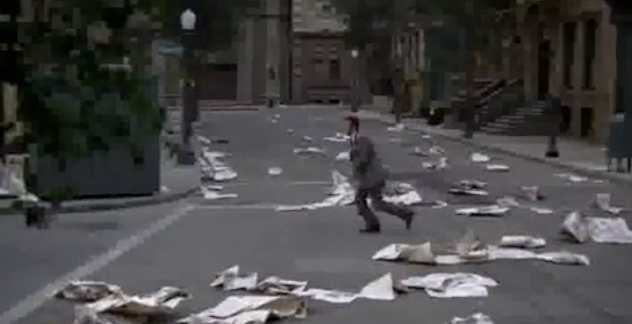
“Encore’s” director, Paul Krasny, keeps things seeming much bigger than they really are. For most of the episode we are in cramped, period sets that Krasny and his director of photography look rich and lush. It really feels like a movie more than an episode of television, never moreso than at the climax:

Kroll has just inadvertently given up the evidence, and suddenly everyone around him seems to evaporate.  Everyone has been pulled out, you see. One would also expect cops would be storming in, but go with it. Kroll wanders out into the period street, so bustling with life just moments prior, and it is now empty and abandoned. Kroll begins running, searching, and as he does so we see the ink put in his hair to shade it run down his cheeks. His wax begins to loosen. His limp returns. But he keeps running…until he runs all the way off the set and onto another one on the backlot: an street from classic shoot-‘em-up Westerns. It’s a wonderful, metaphorical image to end our story. Indeed, we don’t see Phelps apprehending our villain or even anything close to that. Instead, we see Kroll’s second in command, a man in his 60’s like Kroll, approach him – a reminder of who he really is and a mirror image Kroll does not want to look at. That is more of a defeat for him than being hauled off in handcuffs. And also, from the writing to direction, beautifully realized.

Back when I wrote about “Battlestar: Galactica” I noted how awesome it was that they share a sneak preview of what’s to come in the episode, and here I was just as excited to see the same in the opening credits. The show’s iconic theme music plays as we are shown tiny snapshots of exciting moments in the episode to come. Yes, setting Lalo Schifrin’s music against anything, even “Heaven’s Gate,” would make what we are seeing the most exciting action film ever made, and I think that’s the point. It jazzes up the viewer and ensures that he or she will be back and ready for more just as soon as the commercial break is over.

I’m surprised it’s taken me this long to watch the original “Mission: Impossible” television show. I’m a huge admirer of the film series, and now have set my DVR to tape the show’s nightly airing. From glancing at several articles, it appears that “Encore’s” craziness is the exception in the series, not the rule. But even if the show remains (relatively) grounded throughout the rest of its run, that won’t mean I love it any less. I can’t help but love the smoke-and-mirrors game it plays with its viewers and villains every week…and that theme song will never get old.

“Encore” is available on DVD and YouTube.


Route 66 – “Lizard’s Leg and Owlet’s Wing”


Season 3, Episode 6
Original Airdate: October 26, 1962
Writer: Stirling Silliphant
Director: Robert Gist
Producer: Mort Abrahams, Leo Davis
Cast: Martin Milner, George Maharis, Boris Karloff, Peter Lorre, Lon Chaney Jr.

“Lizard’s Leg and Owlet’s Wing” is a fantastic, wrapped present to fans of 1930s and 1940s horror classics. I hesitated for a while to write up an article about this episode because I don’t really think that it fits the definition of “great television” in the way the other shows I have written about here do. The writing here isn’t the best and it’s tonally different than the other “Route 66” installments I’ve seen. But that’s before you insert what I like to call the “awesomeness” factor at play here. I’m just a tad obsessed with those old classic horror movies I mentioned earlier, so to get to see Boris Karloff, Peter Lorre and Lon Chaney Jr. not only interact with one another, but don some of the most iconic film make-up of all time makes me happy in ways I can’t begin to articulate.

The episode opens with a young boy asleep in his bed when what appears to be a hunchback walks in. Turns out it’s just Lon Chaney Jr. (“The Wolf Man” himself, “The Son of Dracula”) wanting to tuck his grandson in, and he’s wearing his father’s get-up from the silent version of “The Hunchback of Notre Dame.” At this point I checked my DVR to make sure this was really “Route 66” and it told me it was. Then we cut to a three-way phone conversation between Chaney, Peter Lorre (perhaps history’s greatest character actor, but know for golden age of horror roles like “Mad Love”) and (cue the Angel chorus) Boris Karloff (“Frankenstein,” “Bride of Frankenstein,” “The Mummy,” “The Old Dark House,” “The Black Cat,” “Isle of the Dead” and so many others, but most horrifyingly the “Mr. Wong, Detective” series for Monogram). At this point I figured I must have accidentally DVR’ed the wrong show.  This must have been writer Stirling Silliphant’s idea for a tricky, surprising teaser, and fifty years later it still works like a charm. In fact, this type of fake-out teaser has been copied many times since in horror series – just think of the “Humbug” episode of “The X-Files.”

The plotlines for the episode are light as a feather and done with an ample amount of good dialogue. Tod (Martin Milner) and Buzz (George Maharis) get a gig at a fancy hotel outside Chicago. Karloff, Chaney and Lorre (playing themselves) have come to discuss a possible television series they would star in and argue about whether they should stick to the old ways (Universal horror) or go the new route (Hammer horror), and Tod must act as their liaison to the hotel…or something. Buzz is in charge of a women’s lib convention and immediately falls head over heels with one of the secretaries there, who is depressed after her boss left her for his fiancé. Seriously. Though the A and B stories couldn’t seem more dissimilar, Silliphant finds ingenious crossovers between them. To prove the old scares are still viable, Chaney dresses up in Wolf Man garb and causes every woman in sight to faint in horror, and Karloff has a surprisingly sweet scene with the depressed secretary where he gives her love advice.

The real attraction here is getting to see the three legends interact with one another, with “the normal people” and dress up as the old favorites. Also, a quick shout-out to Lorre’s suitcase, which is alligator skin, has an actual alligator head as its handle (I’m not kidding) and almost steals the show. It’s always a thrill to see Karloff play a nice guy since his image is so synonymous with grotesquery, and here, playing a version of himself, he has a surprising amount of comedic timing, landing every punchline thrown at him. Lorre had long perfected his depressed-annoyed persona and seems to be having a horrible (meaning wonderful) time onscreen. Chaney is rarely out of make-up here, but I’m sad to report that when he is, he looks absolutely miserable. He can barely land any line other than grunting and seems to have trouble doing, well, anything. I have no idea whether it was his rumored alcoholism or what, but someone definitely needed to give him a Red Bull or something.

Chaney does do a decent job seeming very tortured while dressed up as the aforementioned Hunchback, the Mummy (though Karloff originated the role, Chaney played it in one of the sequels) and, of course, the Wolf Man. I got goosebumps when I saw Karloff in full-on make-up as Frankenstein’s monster, and how can you not? Since “Mad Love” was an MGM vehicle, Lorre must do his best with an evening jacket and evil glare. What makes it even more exciting is that it is the classic Jack Pierce make-up and not some second-rate knockoff.

It’s odd that I’ve come this far in the article with barely a mention of the two main characters, but they are ancillary to the episode at best. Maharis does a good job at being handsome (harder than it seems, I’m told) and has a neat little bit of physical comedy involving a pool. Milner interacts with the horror stars the most, but does the smartest thing possible here: He gets out of their way. The dialogue between the guys is smooth and well-written, and though they both are excellent actors who showcase their talents in other episodes, this isn’t one of them.

Silliphant was a co-creator of “Route 66” and also a show called “Naked City,” which I’m looking forward to sampling soon. Looking at his IMDB page, the diversity of his work and his output is almost staggering. This man wrote for “The Mickey Mouse Club,” “Alfred Hitchcock Presents” and also penned the features “Village of the Damned” and “The Towering Inferno.” In what universe are those works related? Oh, and he was BFF’s with Bruce Lee! This is a writer I need to know more about, and pronto.

I love road trips. When I moved out to Los Angeles to attend the AFI Conservatory, I decided to try and travel down Route 66. I quickly found out that most of the highway is either very out of shape or just gone now, abandoned or paved over by the freeway. It’s a sad state of affairs when gas station attendants don’t actually know that their station is located on Route 66. And yet that time traveling out west remains one I will always remember fondly. I’ll always wonder what that highway, what that world, was like in its heyday, and feel lucky to get a little picture of what it might have been through this series.

“Lizard’s Leg and Owlet’s Wing” is available on DVD and YouTube.

Sunday, January 20, 2013

Downton Abbey - "Episode One"

Series One, Episode One
Original Airdate: January 9, 2011
Writer: Julian Fellowes
Director: Brian Percival
Executive Producers: Rebecca Eaton, Julian Fellowes, Gareth Neame
Cast: Hugh Bonneville, Jim Carter, Maggie Smith


With 18 regular cast members to introduce and about an hour to do it in, it’s shocking that “Downton Abbey” creator/writer Julian Fellowes not only managed to juggle all these characters, plots and subplots, but did so in such a way that kept his audience surprised, shocked and engaged enough to care about almost all of them. With most writers unable to do justice to casts of 5 and 6 in the hundreds of pilots produced today, the fact that Fellowes made the first episode appear so effortless is a tremendous achievement indeed.

The show focuses on the estate of the title and those that inhabit it, both upstairs and downstairs. Upstairs are the Crawleys, headed by the sensible Robert (Hugh Bonneville). Downstairs are the servants, led by the likewise sensible Mr. Carson (Jim Carter) and Mrs. Hughes (Phyllis Logan). In the first of Fellowes’ many brilliant decisions, he stages two “events” that threaten to forever alter the lives the many characters have built for themselves.

The first, which affects the Crawleys, is the sinking of the Titanic, which resulted in the deaths of the two heirs to Downton. If the world was fair, the money should be willed to Robert’s eldest daughter Mary (Michelle Dockery), but a woman can hold no claim to the fortune so, unless the family can figure out something drastic, it will go to some distant cousin who is * gasp! * a lawyer.

The second is the arrival of Robert’s new valet, Mr. Bates (Brendan Coyle). While the arrival of any new servant could possible shake up the downstairs section of a house like Downton Abbey, the transition is further compounded by the fact that Bates walks with a limp and needs to use a cane at all times for support. Mr. Carson and Mrs. Hughes allow Bates to begin work, wary that he’ll be unable to stand the workload, but other servants sense weakness and aim to strike and ensure that Bates is fired so they may benefit.

The series opens by showing us the wires that transmit the message of the Titanic’s sinking juxtaposed against Bates on the train headed toward Downton – their impact on the great house inevitable. I should mention here that this scene is also the first time we hear the amazing theme music for the show, which perfectly captures the show’s tone.

A lesser show with a lesser writer would settle for allowing its characters to act overly emotional in the pilot in order to give us broad strokes as to who they are. Not here. Instead we are simply given a series of small moments and beats – sometimes merely a look – to clue us into who these people are. Note how Fellowes uses the two events to allow us insight into who these people are. How do they react to the news? Do they react at all? Sometimes the lack of someone’s reaction tells us more about him or her than a loud dramatic beat. Take Mary, who was engaged to one of the men who died on the Titanic. Her first reaction is to wonder aloud whether she’ll have to go into full-on mourning for her fiancé. She feels nothing, and that tells us what we need to know about what type of person she is.

For the first half of the episode, the two worlds couldn’t seem further apart. But then we notice connections in the way the Crawleys connive to get Mary to be the rightful heir with how some servants, specifically Mrs. O’Brien (Siobhan Finneran) and Thomas (Rob James-Collier) conspire to get rid of Bates. Turns out people are alike all over. Fellowes plays a wonderful game of smoke and mirrors with the audience concerning a Duke’s (Charlie Cox) arrival. We believe he is there as a possible suitor to Mary. Someone who, despite being a fortune hunter, could save the family. Then something goes amiss. The Duke hardens to the family and no one (not even the viewer) can figure out why. When his real motives are revealed, (Thomas, his lover, is blackmailing him to get a better position and the Duke has come to bring an end to it) the viewer is thrown for a huge loop. More than that, we have hated Thomas up until this point because of his treatment of Bates. But after his lover rejects him and throws him out, the camera lingers on Thomas as he stands in the shadows, on the verge of tears. And suddenly, against all odds, you feel for the man.

Another surprising thing is that both of the schemes here fail. Mary loses the inheritance in the end, and the final scene shows that lawyer (Dan Stevens) getting the news. Bates is indeed sacked, but before he can leave Robert has a change of heart and invites him back. Bates’ storyline is incredibly emotional, though Coyle’s performance never asks for sympathy and the writing never treats his character with the treacle one would expect (a later episode, where Bates tries using a leg brace that causes him great pain, does tip a bit too far into the saccharine). Every time he silently works through the pain and ignores insult upon insult, our hearts go out to him. He can’t help the way he is, we scream at the screen! That is, of course, the entire point. Robert’s final decision to keep Bates reinforces that, through all the scheming and plans, there is a beautiful humanity to these characters one might not expect.

This fascinating, fantastic tightrope act continued for the next five episodes. Fellowes certainly had a lot of fun dipping his cast into melodrama (in one episode a visitor dies on top of Mary, just about to take her virginity, and she must drag him across Downton to his own bed before anyone else wakes up or else the scandal could ruin the family) but then always pulled back before things went to a different level. In the final episode, things were especially heightened, to the point where the drama threatened to define the characters…but then Fellowes pulled the rug out from under viewers once again. Instead of giving us the easy payoffs and happy endings we expected, he left everything mid-stream with the announcement of the war. The show was originally envisioned only as a miniseries, so that ending was especially refreshing – a physical embodiment of Bogie’s line in “Casablanca”: “The problems of three little people don’t amount to a hill of beans in this crazy world.” Maybe they shouldn’t, but to me, they mean oh-so-much.

“Downton Abbey”: Episode One is on Hulu Plus, iTunes, Amazon Prime, DVD and is probably replaying on PBS right now.

Tuesday, January 8, 2013

The X-Files - "The Post-Modern Prometheus"

Season 5, Episode 5
Original Airdate: November 30, 1997
Writer/Director: Chris Carter
Executive Producers: Chris Carter, R.W. Goodwin
Cast: David Duchovny, Gillian Anderson, John O’Hurley, Chris Owens

It’s impossible to choose a “best” episode of “The X-Files” because there are legitimately too many great ones to choose from. More than that, many of the great episodes are scary, some are funny, and others are fantastic mind games. Others are all of the above. Even masterworks like “The Sopranos” and “Seinfeld” have that one episode that can stand as a representation of everything the show can accomplish, but that’s not so with “The X-Files.” The stories, and voices of its writers, are just too varied to allow one hour to represent it. The only other show I can think of off the top of my head like that is “The Twilight Zone,” which puts this program in good company. I chose “The Post-Modern Prometheus” not because it is the show’s “best,” but it’s because it is my favorite.

Each episode would involve FBI Agents Mulder (David Duchovny) and Scully (Gillian Anderson) investigating the unexplainable. Mulder is a true believer in alien abduction, vampires, demons and the forces of evil. Scully, despite being proven wrong in almost every episode, continues to be cynical. The unexplainable occurrence here involves a version of the Frankenstein monster who breaks into women’s houses and inseminates them over the course of several days (he uses termite tents as a way to ensure he’s not caught). Oh, and he has a Cher fetish. Yes, that Cher. If you didn’t grin from ear to ear reading that summation, then there’s just no talking to you. Yes, this is one of the lighter “X-Files,” feeling much more like a fairy tale than a horror movie.

Writer/Director Chris Carter (also the show’s creator) chose to shoot in black-and-white as an homage to James Whale’s two Universal “Frankenstein” films. And indeed the skies are painted grey like in those films, and villagers with pitchforks serve a big purpose in the climax. But there are also numerous nods to Mary Shelley’s original novel, beginning with the name of the episode and in several lines of dialogue (yes, I know Mulder gives us the wrong ending to the novel…shut up!). Despite most of the episode’s characters being, uh, a few watts short of a working lightbulb and mainly obsessed with getting on “The Jerry Springer Show” (Springer has a cameo), the episode is one of the smartest of the series. Every time I revisit the show after a few months or years, I’m always pleasantly surprised by the intricacies of the dialogue, and how the writers never shy away from allowing their two protagonists to sound smart (really, really smart), even if some of the language goes over the heads of viewers. Big words are more and more of a “no-no” in today’s television landscape, and that’s such a shame because, looking back on the literacy of shows like “The X-Files” is almost like visiting a foreign planet (ugh, I’m so sorry for that pun, but not sorry enough to erase it).

The subject matter and the tone of “The Post-Modern Prometheus” prove just how versatile the series can be and what kinds of chances it was willing to take on a regular basis (I did mention the Cher fetish, right?). The black-and-white was a brilliant decision, and Joel Ransom’s work as cinematographer is absolutely sterling. The world is gorgeous to look at, and Gillian Anderson has never looked lovelier than here.

One thing that I don’t think “The X-Files” gets enough credit for is its inherent humanity. For a show that is, at its base, about scares and little green men, a lot of screentime and effort is taken to develop its one-off characters who may or may not survive ‘til the end of the hour. Similar horror shows treat them simply as monster bait, but here the writers genuinely attempt to make us care about these victims…and in the case of this episode, its monsters as well.  In the final act, the monster (Chris Owens, later to play Jeffrey Spender) gets a chance to explain his actions and the horrors he has apparently acted out to his “victims.” The scene is beautifully written and staged, but the kicker is what comes next. Carter ends the episode set to Cher’s cover of “Walking in Memphis,” with the monster actually getting to attend a Cher concert, where Cher (be still my heart) embraces him and takes him onstage with her. Totally unrealistic? Sure, but who cares? This is a fairy tale, and no one wants realism in one of those. Bonus points for letting Scully smile, which is something which doesn’t happen often enough in the show’s 202 episodes.

Yes, 202 episodes (plus two movies). It’s shocking how consistently great the show was during its entire run. The final few seasons got a lot of criticism while still airing for not being up to the standards of earlier episodes, but re-examining them today with fresh eyes reveals that the show remained great up until the very end. Episodes like “Roadrunners,” “Via Negativa,” “Daemonicus” and “Improbable” easily stand with the best “X-Files.”

“The Post-Modern Prometheus” just eeked its way past “Home,” “Triangle,” “Bad Blood” and the Darin Morgan installments to be the first “X-Files” episode I wrote about, though I’m sure several of the above will have their own columns soon. The fantastic thing that allowed “The X-Files” to last so long and work so well in different tones and genres was that it could be about anything just so long as it was something we, as human beings, cannot understand yet. Yes, that involved a lot of darkness, but it had a lot of hope as well. It is also one of the shows that made me want to be a writer.

“The Post-Modern Prometheus” is available on DVD, iTunes, Hulu Plus and Amazon Prime.

Saturday, December 22, 2012

The Outer Limits - "Demon With a Glass Hand"

Season 2, Episode 5
Original Airdate: October 17, 1964
Writer: Harlan Ellison
Director: Byron Haskin
Producer: Ben Brady, Leslie Stevens
Cast: Robert Culp, Arline Martel

“Demon With a Glass Hand” is a wonderful, complex science fiction story hidden underneath a beautifully shot film noir. It was “Blade Runner” long before that huge Geisha appeared on the skyscraper…and has better voice-over to boot. Writer Harlan Ellison sued the studio behind “TheTerminator” for plagiarizing his other (lesser) “Outer Limits” episode “Soldier” in a move that, to this writer, seems like quite a stretch. But though the mythology here is much different than “Blade Runner,” it’s impossible to not see all the inspirations, from the emotionless hero to the final twist.

Despite my obsession with all things “Twilight Zone” and love for anthology series in general, I’ve never before watched “The Outer Limits,” despite having the original series on DVD for a few years now. After finally digging in and watching several of the most popular episodes (“The Zanti Misfits,” “The Chameleon” and “Soldier,” among others), I was very much let down. Despite gorgeous cinematography and some good acting, the one-hour format stretched most of these science-fiction stories to their breaking point, despite very good ideas at their core. When half of your episodes feel like filler, you have a problem – the same one that “The Twilight Zone” dealt with when it expanded to an hour in its fourth season.

That’s one of the reasons why “Demon With a Glass Hand” (whose name doesn’t really make sense in retrospect) feels like such a breath of fresh air. Instead of filler scenes placed upon other filler scenes, writer Ellison provides us with an ever-changing Rubik’s cube of mythology, often so dense that the viewer is playing catch-up. It begins with a man named Trent (Robert Culp, purposely wooden) lost in modern times with a partially-constructed glass hand and several alien killers on his tail who are recognizable because they wear panty hose (not kidding) on their faces. Trent has no idea who he is, only that he supposed to be humanity’s savior, and he must retrieve the three missing fingers for the glass hand to understand entirely what has happened to him and what he must do to save the humanity of the future. And trust me, I’m just scratching the surface here. There’s more, lots more.

The first ten minutes of the episode feel like an exposition bomb has gone off. First Trent gets a boatload of information from the mysterious panty hose aliens, then more exposition from his hand, then he meets up with a woman and explains even more to her. It’s difficult to keep everything straight and would usually signal very clunky writing, but because Trent is almost as confused as we are, the exposition dump actually works to the episode’s advantage. We go along for the ride, waiting for pay-offs to mysteries we only half understood to begin with, and when those pay-offs come they are both surprising and fascinating.

Everything speeds up once Trent gets to an office building where the aliens are headquartered. Though director Byron Haskin and his fantastic cinematographer Kenneth Peach employed the shadows of noir from the first frame of the episode, the noir look goes into overdrive in this beautifully rendered building, filled with fantastic architecture and maze-like hallways. It reminds me a lot of the office in Billy Wilder’s “Double Indemnity,” and I wasn’t surprised to read that Ridley Scott used the sameplace to film the third act of “Blade Runner” (there’s that movie again).

Trent runs into a woman named Consuelo (Arline Martel) who was working late and turns her into his companion, not by choice, but because the aliens have put an invisible barrier around the building. Together they move up the several floors of the building, ultimately to the roof, before Trent descends back into the danger below as Dante did into the inferno.

"Cowabunga, dude!"
Many of the more sci-fi elements of the episode are almost laughable, and this is true of the show in general. The killer ants in “Zanti Misfits” had cute teddy bear faces and were obviously horrible models swung on strings during the final siege. The aquatic monster in “Tourist Attraction” would have fit better as one of Ariel’s pets in “The Little Mermaid” than on “The Outer Limits.” Here Trent’s glass hand isn’t the most impressive prop (and, for a long period of time, is stuck in a “Cowabunga, dude!” position). The aliens all wear a big necklace that, when torn off of them kills them and sends their bodies back to the future – and yet none of them think they might be safer if they just tuck it into their shirt. And I did mention the panty-hose faces, right?

I’m willing to forgive many of these in part because of the show’s budget, time period and that, yes, “The Twilight Zone” had many shoddy effects too. But what really saves the more eye-rolling parts of the production are the film noir elements. Even the most laughable costumes look awesome when shot in shadow, and the kookiest villains look menacing when you can barely get a good look at them. It’s inspired that Trent and the aliens use guns, actual guns, to do their battle. Ellison apparently was horribly unhappy with that decision, but seriously, what adaptation of his work has he not all-but-disowned after the fact, and here the guns bring a unique level of urgency to the storytelling missing from other science fiction (the guns used here are infinitely scarier than, say, the ray gun from Ellison’s other episode “Soldier”).

The twist at the end of the episode is a genuinely surprising one that hits the viewer on both an emotional and intellectual level, and fits perfectly in the world of noir. It is also darker and self-defeating than one would expect from an anthology, a trait that seems to be repeated throughout almost every “The Outer Limits” episode I’ve seen. Humanity always sucks, things never get better, and our heroes must consistently suffer for little reward. It’s a very dire notion for stories whose imagination is supposed to reach from the inner mind to the outer limits, and perhaps that’s another reason why I haven’t become fully invested in the series. The ending worked beautifully here, that’s for sure, but in the other episodes I’ve seen it just felt tacked-on, as if it was trying to prove a point. Ah well, the show still has many great qualities and I’m looking forward to diving into the remainder of the episodes. I will say one thing about it: the opening credits are much cooler than any of those in “The Twilight Zone’s” history. So that’s, uh, something.

“Demon With a Glass Hand” is available on DVD, AmazonInstant Video, Hulu, iTunes and YouTube.