Showing posts with label Action. Show all posts

Monday, February 25, 2013

Southland - "Graduation Day"


Season 3, Episode 10
Original Airdate: March 8, 2011
Writers: John Wells (teleplay), Heather Zuhlke (story)
Director: Christopher Chulack
Executive Producers: Christopher Chulack, John Wells
Cast: Ben McKenzie, Regina King, Shawn Hatosy, Michael Cudlitz

For a show whose survival has been nothing short of miraculous and whose storytelling is consistently brilliant, “Southland” never seems to get the respect it deserves. Everyone I’ve recommended the show to doesn’t seem to know it exists or thinks its been long-cancelled, and yet when they actually watch an episode they end up addicted. And while I came close to choosing the nearly-flawless pilot for this article, “Graduation Day” represents the show at its creative peak, and part of what makes this episode special is that it should not logically exist.

The premise of “Southland” is as simple as they come – it follows the day-to-day lives of a handful of Los Angeles police officers and detectives. No huge meta twist, no quirky detective protagonist…just real people trying to stay above water while doing one of the most emotionally taxing, physically dangerous jobs on the planet. It premiered on NBC as a midseason replacement to decent ratings and was renewed for a second season shortly thereafter.

Then the great NBC Jay Leno experiment came into play.

For those unfamiliar, for a season NBC wiped all original programming from their 10 o’clock hour and replaced it with a Jay Leno talk show that premiered to huge ratings but then quickly floundered. Because of “Southland’s” dark content, NBC’s executives allegedly became very uncomfortable with airing it at 9 p.m. and cancelled it before it even had a chance to premier, with six episodes already filmed.

TNT, a network known more for “The Closer” than for gritty, realistic drama, swooped in and agreed to air the six unaired season two episodes. Then, miracle of miracles, the network picked it up for a third season of ten episodes with a much-reduced budget…and the results are some of the best television I have ever seen. It’s not often that a show has a “perfect” season, and even now I can count them on a single hand…but, to me, the season is just about as perfect as they come. The show seemed to flourish under the budget cuts, taking more chances and finding inventive (and often heartbreaking) ways to trim its cast. The storytelling was more honest and streamlined – and now the show is in the middle of its fifth season. All with a fraction of the critical acclaim lavished on shows like “Girls” or “Boardwalk Empire.”

But back to “Graduation Day” which, despite being the third season finale, is only the 23rd episode of the series. The brilliant John Wells (who helped to craft such masterworks as “The West Wing” and “E.R.”) wrote the script based off a story by Heather Zuhlke, and together they paid off storylines that had legitimately been building since the first episode of the series. I’m guessing that they went into the episode assuming that it would be a series finale, which is why there is an added sense of urgency to almost every scene.

The theme of the hour, underlined by its title, is one of transitions for every cast member. Ben (Ben McKenzie) is graduating from boot cop. Cooper (Michael Cudlitz) finally must face his painkiller addiction head on. Sammy (Shawn Hatosy) finally catches the scum who murdered his partner and welcomes his son into the world. Chickie (Arija Bareikis) is moving on from her partnership with Dewey (C. Thomas Howell), who doesn’t know how to deal with it. And Lydia (Regina King) explodes the finally stable relationship she has with her partner.

As with any episode of “Southland,” it’s all about the moment-to-moment encounters these officers have and how those small beats build up to a cohesive whole. A career. A life. In a scene that could easily have come across as throwaway, Ben and Cooper are called to a house where a mother is livid that her husband allowed a gang symbol to be tattooed on their six-year-old son. The scene plays almost comically at first, but then we see the young boy point his finger at Cooper repeatedly and pretend to be shooting him. And suddenly, our hearts break. We understand the struggle they go through and recognize how much these cops must feel like they are punching water on a day-to-day basis.

Another beautifully realized moment: Sammy learns that there is a warrant out against the man he knows killed his partner, though not for the murder. The thug is involved in a shootout and Sammy races to the thug just in time to see him bleeding to death. Instead of comforting him or walking away, Sammy leans into the guy’s face and repeats his partner’s name, Nate Moretta, over and over until the man is dead. It’s immensely powerful and a fantastic way to climax the main arc of the season, but one can’t help but be a little horrified by it. In other words, it’s great drama.

As if that wasn’t enough, the centerpiece of the finale is a fantastic foot chase between Ben and a rapist/kidnapper, with the drug-addled Cooper far behind and barely able to walk, let alone lend support his partner. In fact, there’s a moment where Cooper is climbing over a fence and we see his entire body shift and crack before he falls that is one of the most cringe-inducing I’ve ever seen. The action moves to a series of rooftops that Jimmy Stewart should really avoid. Director Christopher Chulack (who directed many of “Southland’s” best hours) gives the sequence a great build and tension, never allowing the scope of the set-piece outmeasure the grittiness of its circumstances. There’s a down-and-dirty hand-to-hand fight between Ben and the rapist that is punctuated with a climax that left my jaw on the floor thanks to a really, Really, REALLY amazing stunt (the show’s only Emmy love comes from its stuntwork, which is always aces).

In all of its most important episodes, the writers find new shades and uses for the simple phrase “I’m a cop.” In the pilot Ben says it, in the second-season finale Chickie says it while arresting a cop-impersonator. Here the statement, so important and iconic to the series, it spoken by Cooper while he is volunteering for detox before he can have back surgery. He’s broken mentally and physically, but still a person. Still human. And that’s what “Southland” so perfectly portrays. Its characters are flawed, sometimes horrible, but ultimately good…and we can’t help but love them for it. This is a fantastic show, one whose reputation will certainly grow over time. Take my word for it; “Southland” is a modern classic…most people just don’t know it yet.

“Graduation Day” is available on iTunes and DVD.

Monday, January 28, 2013

Mission: Impossible – “Encore”


Season 6, Episode 2
Original Airdate: September 25, 1971
Writer: Harold Livingston
Director: Paul Krasny
Executive Producer: Bruce Geller
Cast: Peter Graves, Lynda Day George, William Shatner

I had never seen an episode of “Mission: Impossible” before this one. So I have no idea if “Encore” is a good representation of the rest of the series, but I really hope it is. Everything about it is legitimately insane, and yet the story is told with such style and conviction that, in its own weird way, it’s pretty close to perfect.

We begin with IMF (a super-secret government branch where all the agents have really awesome hair) team leader Jim Phelps (Peter Graves) getting his assignment of the week: to ascertain a confession and evidence against a murderer/mobster/all-around-evil-guy Thomas Kroll (Captain James T. Kirk…er…William Shatner). Kroll is in his 60s and just exploded a hospital where a little ‘ole lady was about to snitch on him, so we know he’s bad to the bone.

So IMF decides to (wait for it) make Kroll believe he has traveled back in time to save some humpback whales to 1937, the date he first met the woman he would ultimately kill in that hospital.

Yes, you read that right.

Okay, let’s break this down for a minute, shall we? They drug Kroll with a hot towel and kidnap him and give him a makeover. How can they make a 60-something guy with a limp appear to be in his 30s again, you ask? Well, they cover his face with wax and other magical elements and shoot his bad leg with a drug that will take away his limp. Phelps has rented out a film backlot and meticulously recreated at least two blocks from Kroll’s old neighborhood, right down to the buttermilk in his icebox. Oh, and I should mention that all of this appears to have been done in about 24 hours.

Like I said, this is nuts. And it would be completely laughable if it wasn’t done with complete conviction from everyone involved. Also, the viewer has to take a huge leap of faith, but as far as I’m concerned, I don’t want to watch a show called “Mission: Impossible” without muttering “that’s impossible!” to myself at least twice in a given episode. And even though the premise is…uh…farfetched, writer Ron Livingston creates some really smart complications among the impossible leaps. For example, the magic face wax and leg drug will only work for six hours.  And Kroll doesn’t act stupidly for a man in his situation. He scrubs his face thoroughly to ensure there’s no makeup to make him look younger. He rushes to a window when he hears a plane overhead (It’s a 1930s plane Phelps had fly over to help with the cover. These guys think of everything). More than that, above and beyond the time-travel trick, what we are witness to is a very elaborate mind game – almost a game of chess between a mostly unseen Phelps (who only interacts with Kroll once) and Kroll’s better instincts.

Yes, there are a thousand different ways this story is implausible and also a thousand ways that Kroll could make the team. I don’t care, because while the episode is playing, it’s all too much fun. Livingston actually takes more time that one would expect at turning Kroll into a legitimate character. Of course any 60-something guy magically back in the body of a 30-something-year-old would immediately want to chase some tail, and that’s what Kroll does, taking the “woman” he will eventually kill to a movie and making none-too-subtle remarks about wanting to get with her. That’s just creepy on so many levels.

“Encore’s” director, Paul Krasny, keeps things seeming much bigger than they really are. For most of the episode we are in cramped, period sets that Krasny and his director of photography look rich and lush. It really feels like a movie more than an episode of television, never moreso than at the climax:

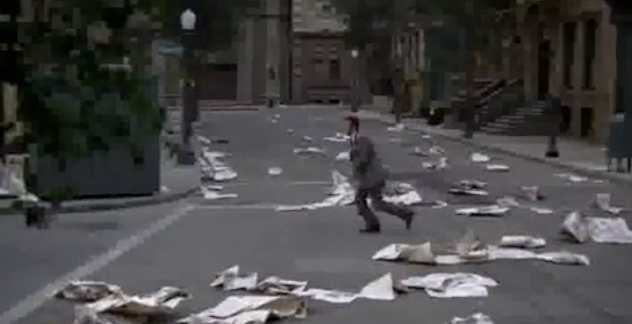
Kroll has just inadvertently given up the evidence, and suddenly everyone around him seems to evaporate.  Everyone has been pulled out, you see. One would also expect cops would be storming in, but go with it. Kroll wanders out into the period street, so bustling with life just moments prior, and it is now empty and abandoned. Kroll begins running, searching, and as he does so we see the ink put in his hair to shade it run down his cheeks. His wax begins to loosen. His limp returns. But he keeps running…until he runs all the way off the set and onto another one on the backlot: an street from classic shoot-‘em-up Westerns. It’s a wonderful, metaphorical image to end our story. Indeed, we don’t see Phelps apprehending our villain or even anything close to that. Instead, we see Kroll’s second in command, a man in his 60’s like Kroll, approach him – a reminder of who he really is and a mirror image Kroll does not want to look at. That is more of a defeat for him than being hauled off in handcuffs. And also, from the writing to direction, beautifully realized.

Back when I wrote about “Battlestar: Galactica” I noted how awesome it was that they share a sneak preview of what’s to come in the episode, and here I was just as excited to see the same in the opening credits. The show’s iconic theme music plays as we are shown tiny snapshots of exciting moments in the episode to come. Yes, setting Lalo Schifrin’s music against anything, even “Heaven’s Gate,” would make what we are seeing the most exciting action film ever made, and I think that’s the point. It jazzes up the viewer and ensures that he or she will be back and ready for more just as soon as the commercial break is over.

I’m surprised it’s taken me this long to watch the original “Mission: Impossible” television show. I’m a huge admirer of the film series, and now have set my DVR to tape the show’s nightly airing. From glancing at several articles, it appears that “Encore’s” craziness is the exception in the series, not the rule. But even if the show remains (relatively) grounded throughout the rest of its run, that won’t mean I love it any less. I can’t help but love the smoke-and-mirrors game it plays with its viewers and villains every week…and that theme song will never get old.

“Encore” is available on DVD and YouTube.


Tuesday, January 8, 2013

The X-Files - "The Post-Modern Prometheus"

Season 5, Episode 5
Original Airdate: November 30, 1997
Writer/Director: Chris Carter
Executive Producers: Chris Carter, R.W. Goodwin
Cast: David Duchovny, Gillian Anderson, John O’Hurley, Chris Owens

It’s impossible to choose a “best” episode of “The X-Files” because there are legitimately too many great ones to choose from. More than that, many of the great episodes are scary, some are funny, and others are fantastic mind games. Others are all of the above. Even masterworks like “The Sopranos” and “Seinfeld” have that one episode that can stand as a representation of everything the show can accomplish, but that’s not so with “The X-Files.” The stories, and voices of its writers, are just too varied to allow one hour to represent it. The only other show I can think of off the top of my head like that is “The Twilight Zone,” which puts this program in good company. I chose “The Post-Modern Prometheus” not because it is the show’s “best,” but it’s because it is my favorite.

Each episode would involve FBI Agents Mulder (David Duchovny) and Scully (Gillian Anderson) investigating the unexplainable. Mulder is a true believer in alien abduction, vampires, demons and the forces of evil. Scully, despite being proven wrong in almost every episode, continues to be cynical. The unexplainable occurrence here involves a version of the Frankenstein monster who breaks into women’s houses and inseminates them over the course of several days (he uses termite tents as a way to ensure he’s not caught). Oh, and he has a Cher fetish. Yes, that Cher. If you didn’t grin from ear to ear reading that summation, then there’s just no talking to you. Yes, this is one of the lighter “X-Files,” feeling much more like a fairy tale than a horror movie.

Writer/Director Chris Carter (also the show’s creator) chose to shoot in black-and-white as an homage to James Whale’s two Universal “Frankenstein” films. And indeed the skies are painted grey like in those films, and villagers with pitchforks serve a big purpose in the climax. But there are also numerous nods to Mary Shelley’s original novel, beginning with the name of the episode and in several lines of dialogue (yes, I know Mulder gives us the wrong ending to the novel…shut up!). Despite most of the episode’s characters being, uh, a few watts short of a working lightbulb and mainly obsessed with getting on “The Jerry Springer Show” (Springer has a cameo), the episode is one of the smartest of the series. Every time I revisit the show after a few months or years, I’m always pleasantly surprised by the intricacies of the dialogue, and how the writers never shy away from allowing their two protagonists to sound smart (really, really smart), even if some of the language goes over the heads of viewers. Big words are more and more of a “no-no” in today’s television landscape, and that’s such a shame because, looking back on the literacy of shows like “The X-Files” is almost like visiting a foreign planet (ugh, I’m so sorry for that pun, but not sorry enough to erase it).

The subject matter and the tone of “The Post-Modern Prometheus” prove just how versatile the series can be and what kinds of chances it was willing to take on a regular basis (I did mention the Cher fetish, right?). The black-and-white was a brilliant decision, and Joel Ransom’s work as cinematographer is absolutely sterling. The world is gorgeous to look at, and Gillian Anderson has never looked lovelier than here.

One thing that I don’t think “The X-Files” gets enough credit for is its inherent humanity. For a show that is, at its base, about scares and little green men, a lot of screentime and effort is taken to develop its one-off characters who may or may not survive ‘til the end of the hour. Similar horror shows treat them simply as monster bait, but here the writers genuinely attempt to make us care about these victims…and in the case of this episode, its monsters as well.  In the final act, the monster (Chris Owens, later to play Jeffrey Spender) gets a chance to explain his actions and the horrors he has apparently acted out to his “victims.” The scene is beautifully written and staged, but the kicker is what comes next. Carter ends the episode set to Cher’s cover of “Walking in Memphis,” with the monster actually getting to attend a Cher concert, where Cher (be still my heart) embraces him and takes him onstage with her. Totally unrealistic? Sure, but who cares? This is a fairy tale, and no one wants realism in one of those. Bonus points for letting Scully smile, which is something which doesn’t happen often enough in the show’s 202 episodes.

Yes, 202 episodes (plus two movies). It’s shocking how consistently great the show was during its entire run. The final few seasons got a lot of criticism while still airing for not being up to the standards of earlier episodes, but re-examining them today with fresh eyes reveals that the show remained great up until the very end. Episodes like “Roadrunners,” “Via Negativa,” “Daemonicus” and “Improbable” easily stand with the best “X-Files.”

“The Post-Modern Prometheus” just eeked its way past “Home,” “Triangle,” “Bad Blood” and the Darin Morgan installments to be the first “X-Files” episode I wrote about, though I’m sure several of the above will have their own columns soon. The fantastic thing that allowed “The X-Files” to last so long and work so well in different tones and genres was that it could be about anything just so long as it was something we, as human beings, cannot understand yet. Yes, that involved a lot of darkness, but it had a lot of hope as well. It is also one of the shows that made me want to be a writer.

“The Post-Modern Prometheus” is available on DVD, iTunes, Hulu Plus and Amazon Prime.

Sunday, August 12, 2012

Alias - "Phase One"

Season Two, Episode 13
Original Airdate: January 26, 2003
Writer: J.J. Abrams
Director: Jack Bender
Executive Producer: J.J. Abrams, Ken Olin
Cast: Jennifer Garner, Michael Vartan, Victor Garber, Carl Lumbly

When television shows reinvent themselves, it is usually because producers or the network think that the storytelling has gone off course or stagnated…or because a popular actor is leaving his or her role. You rarely see it done on a “healthy” show. Sure, shows like “24” claim to hit the reset button every season, but then a mole always shows up in CTU and Jack ends up in handcuffs again. Off the top of my head I can think of the “Two Fathers/One Son” episodes of “The X-Files” that brought to a head six years of complex mythology, Roseanne’s family winning the lottery and the complete creative makeover of “The Practice” in its final season before it transformed into “Boston Legal.” And then there is “Phase One,” which feels for most of its running time like a series finale before upending our expectations and setting the stage for a completely revamped version of “Alias.” The show would pull a similar change-up at the end of this season and several other times during its five-season run, but “Phase One” remains the best of the bunch and one of the most engaging episodes of adventure television ever produced.

Up until this point, the series focused on secret agent Sidney Bristow (Jennifer Garner), who believed she was working for the CIA until they killed her fiancé. She then realized she was working for a terrorist cell called SD-6 and became a double agent, working with the real CIA to take down SD-6 with her father Jack (Victor Garber), who was also a double agent. Also, Sidney’s mom had shown up and there was all this stuff about a dude named Rambaldi and a floating red ball filled with water and Francie (Merrin Dungey) had just opened a restaurant. Phew.

When you consider the circumstances surrounding the production of this episode, it’s a miracle it’s even comprehensible—let alone awesome. You see, “Alias” was chosen to be the show that immediately followed the Super Bowl. This was an opportunity for showrunner J.J. Abrams (who also wrote the episode) to attract a lot of new eyeballs, but getting those viewers up to speed on the complex mythology (see above) and who is who was not exactly an easy task. Instead of just making the episode a jumping-on point, which was the logical thing to do, Abrams instead decided to get viewers up to speed on the mythology…and then blow it up by the end. All in a 42 minute running time.

Shockingly, Abrams pulled it off with a lot of style and still manages to insert several beautiful character moments that had become a hallmark of the series. Turns out the guy is pretty good at this kind of thing—think of his reboot/sequel “Star Trek,” (which was co-written by “Alias” writers Alex Kurtzman and Roberto Orci), which boiled down decades of “Star Trek” mythology to its essentials while still telling a coherent, enjoyable story that could attract new viewers.

The black one.
Apparently eager to ensure male viewers would stick around, the episode opens with Sidney on a private plane strutting her stuff in black underwear…then re-strutting it in red underwear. The camera lingers on her assets in an almost exploitative manner (while AC/DC plays in the background, no less!), but Abrams and his director Jack Bender almost immediately upend this male-fantasy by having Sidney kicking the ass of the guy oogling her (“What was wrong with the black one!?” she hisses as she strangles him, before continuing, “You think it’s comfortable wearing clothes like this?”). There’s a fight scene that leaves Sidney in mortal jeopardy and then we flash back one day earlier.


The red one.
Even though series supervillain Arvin Sloan (Ron Rifkin) is mostly M.I.A. here, Abrams introduces a new, wonderful baddie named Geiger, played by Rutger Hauer, who has been inserted as acting director of Sidney’s branch of SD-6. As if having The Hitcher in the episode wasn’t enough, there’s also a cameo by The Tall Man (Angus Scrimm) as a computer expert. “Alias” was a show unafraid to showcase its geek roots, and also had small roles for such greats as Quentin Tarantino and David Chronenberg.

Admittedly, the plot centers on a deus ex machina. All of the information needed to take down SD-6 just happens to be aboard the plane we see Sidney fighting in during the opening sequence. But Abrams does a fantastic job of dressing up the deus ex machina so well you barely even notice. First there is the aforementioned playing with time, then the ticking-time-bomb aspect to the information that can only be solved by Sidney admitting everything to her best friend in SD-6, Dixon (Carl Lumbly), because he has to send a confirmation code to the CIA in order for them to take down the enemy. Got all that?

The scene where Sidney tells Dixon that his entire life is a lie hits you like a punch to the gut, and rightfully so. In the pilot, we weren’t as emotionally invested in Sidney’s realization because we barely knew her as a character, but here the weight of the revelation is given time to sink in. Abrams even allows time for Dixon, convinced he may die that day, to call his wife to tell her he loves her. The emotional stakes are much higher than just Dixon’s arc, though: Jack is discovered to be a double agent, kidnapped and tortured at length by Hauer’s character to see who he is working for. There’s another beautifully written small scene where, in the midst of the torture, Jack tells Geiger that they actually had dinner together one night, and they laugh as they share memories of the moment. It’s completely throwaway but humanizes Geiger (who until this point has come off as oily as Lex Luthor) and makes us root for Jack all the more.

And then there’s the action. The episode’s centerpiece is indeed the plane sequence, and when it’s revisited halfway through, the tension escalates until Sidney is forced to blow out the side of the plane, cause it to crash and manages to jump out of it with a parachute at the last moment. The set-piece looks and feels very expensive (the CGI work is feature-worthy), and seems like a sly tip-of-the-hat to the climax of “Goldfinger.”

Oh, and Sidney also makes out with Vaughan (Michael Vartan).

Oh, and Francie is killed and replaced with an evil identical version.

That’s one hell of a lot for one episode, and most of what Abrams does is directly against everything television writers are taught. You are never supposed to change the premise of the show so much that it becomes unrecognizable. You are never supposed to get your will-they-won’t-they couple together before the series finale. And this especially should not happen only halfway through the season. But if all this is so wrong, then why does it feel so right?

“Phase One” is available on the second season DVD of “Alias” and on Youtube. Sorry, no Hulu or iTunes this time.

Sunday, July 15, 2012

Buffy the Vampire Slayer : "Hush"

Season 4, Episode 10
Original Airdate: December 14, 1999
Writer/ Director/ Executive Producer: Joss Whedon
Cast: Sarah Michelle Gellar, Nicholas Brendon, Alyson Hannigan, Anthony Stewart Head

Television is supposed to be a visual medium, and yet it consistently seems like you would be hard-pressed to find a lot of support for that statement on the air. Plopped in our living rooms as a replacement for radio, during the ‘50s, many shows were originally broadcast live, meaning there was barely any camera movement or location change. Multi-camera sitcoms didn’t help matters in terms of visual invention, at least not until “Sports Night” came along. You could see the actors, sure, but the spoken word was still the key. Flash forward to today, and that still seems to be the rule. Because of budget constraints, most television shows are stuck in courtrooms, crime scenes and apartment buildings. Reality shows shake their cameras and make everyone look like a clone of Lauren Conrad by using the same filters. As a writer and lover of fantastic dialogue, this doesn’t bother me (love ‘ya, Aaron, Amy and David!), but you still have to stand up and applaud when a creator allows you to experience television storytelling in a new way.

Going into its fourth season, “Buffy the Vampire Slayer” had become famous for the snappy dialogue and excellent characterization that was spearheaded by show creator Joss Whedon. Also for never being nominated for any major Emmys. Maybe Whedon was complimented one too many times on his snappy dialogue. Maybe he had just caught a Charlie Chaplin marathon on Turner Classic Movies. Or maybe he just sensed that the fourth season of his show wasn’t connecting like the others, and decided to throw out the rulebook.

“Hush” represents the peak in quality for a show that was regularly excellent. Despite doing something so off the beaten path, it still manages to completely embody the “Buffy the Vampire Slayer” viewers tuned into every other week. Buffy was still Buffy and the tone and humor was in line with what we always expected. But by getting rid of dialogue, Whedon underlined that he didn’t need the banter to make the show special. It already was.

Whedon opens the episode with a dream sequence, complete with a little blonde girl who sings a song about the monster-of-the-week. When a show goes out of its way to craft a horrifying song about its creatures (called The Gentlemen) and then puts the lyrics into the mouth of the creepiest being on the planet (those with young blonde girls as children will certainly back me up here), you know that the show is going to go for the throat. I did not mean that last part to be a pun, but I’m going to go with it.

The teaser and first act are filled with all the usual witty witticisms, though purposefully a little more stale than usual. This is to underline that words can be used as a means to block communication as often as it is used to embrace it. Buffy (Sarah Michelle Gellar) and Riley (Marc Blucas) talk, talk, talk instead of actually admitting their feelings. Anya (Emma Caulfield) is angry with Xander (Nicholas Brendon) because he won’t put a label on their “relationship.” My beloved Tara (Amber Benson) is completely unable to speak in her Wicca group because everyone else is talking about things that don’t matter. And then the Gentlemen arrive, open up a box and everyone loses their voice.

The initial realization of the mass mutism (I think I created a word there) is brilliantly written and staged. Buffy and Willow (Alyson Hannigan) have a panicked conversation in their dorm room where you can almost…almost tell what they are trying to say by lip reading. Xander panics and tries to call Buffy, only to realize the moment she picks up the phone that neither can do anything to communicate that way. Riley is almost killed because the elevator to the military compound needs voice recognition. And there’s a fantastic beat, so simple to describe yet ingenious in execution, where a random student drops a bottle and the viewer jumps out of his seat. All of this is set to the fantastic music of Christophe Beck, who makes the affair feel like a classic Universal horror movie. There have been a few other television episodes that used a lack of dialogue as a storytelling technique (“The Twilight Zone” episode “The Invaders” comes to mind), but never like this. In fact, dare I say that no other show in the history of television could have pulled this type of storyline off successfully in the way this episode of “Buffy the Vampire Slayer” did? I think I do dare.

Yes, there is some dialogue sprinkled into the episode, most notably when the characters watch a news program and when Maggie Walsh (Lindsay Crouse) uses a machine that verbalizes what she types. But these beats feel like network notes more than something that creatively blossoms from the situation. But for the most part, Whedon creates a purpose for his lack of words. Buffy and Riley embrace their relationship in a way they could not do when they could speak. Xander beats up Spike (James Marsters) after misinterpreting a situation with Anya, proving that he cares about her. Tara proves stronger than expected when she connects with Willow. And all the while we get genuine belly laughs out of the situation. Buffy gets the eyebrows of her friends raised when she makes a questionable motion in her chair at the Scooby summit, and later gets angry with Giles’ drawing of her because the hips are too big. Gellar’s performance in the episode is really a revelation, able to perfectly switch gears from humor to pathos to fighter in an instant.

And did I mention the episode is genuinely frightening? Though there was a lot of suspense to be found in the best episodes of “Buffy,” it wasn’t exactly known to cause the same goosebumps and generate the same scares shows like “The X-Files” and “The Night Stalker” did. But here the Gentlemen and their straight-jacket-clad minions are scary as hell. They look like a skeleton that has grown skin, if that makes sense, and their make-up design is an obvious tip of the hat to Lon Chaney’s make-up in the original “Phantom of the Opera.” It feels like a lot of time (and the budget) went into crafting the monsters, their lair and their method of transportation (floating a few inches over the street), and the result is a villain for the ages.

After the triumph of “Hush,” which earned the only major Emmy nomination in the show’s history, for Best Writing, Whedon began experimenting much more often (usually to great success) in storytelling techniques. The fourth season finale related all the main characters’ dreams. The season five episode “The Body” remains the heart-wrenching examination of death in television (hell, for my money television and film) history. And then there’s the musical episode “Once More, With Feeling.” To be bluntly honest, “Buffy the Vampire Slayer” was the reason I wanted to become a television writer, and this episode changed the way I look at storytelling. Any single episode that can do that is some kind of special.

“Hush” is available on Buffy’s fourth season DVD, Amazon Prime, iTunes and Hulu Plus (ugh).

Thursday, July 12, 2012

Battlestar Galactica : "33"

Season One, Episode One
Original Airdate: January 14, 2005
Writer: Ronald D. Moore
Director: Michael Rymer
Executive Producers Ronald D. Moore, David Eick
Cast: Edward James Olmos, Mary McDonnell, James Callis, Tricia Helfer

The series premier of “Battlestar Galactica” had quite the trick to pull off. This was the beginning of a series follow-up to a 2004 miniseries, which was itself a remake of a 1978 one-season wonder that garnered big ratings but ultimately proved too expensive to maintain. It had to get new viewers up-to-date quickly and convince those who didn’t like the miniseries that it was still a viable, good show.

The original “Battlestar: Galactica” (note the colon) was basically supposed to be the television version of “Star Wars,” and was honestly quite fun. A race of robots called the Cylons have wiped out most of mankind, and the final survivors (led by the ship from the title) race into the darkness on the hunt for a planet of legend called earth. The remake retained that, and nothing else. When fans of the original saw the complete change in tone, style and…well…everything that the miniseries was, they were none too happy. It was darkness upon darkness, more akin to “Saving Private Ryan” than “Star Wars.” I remembered watching the miniseries then going on a message board (because back when I was a teenager I still went on message boards, whereas now I spend my time doing more constructive things…like blogging) and writing “Who gives a frak about whether all these assholes live or die? If I don’t care about the characters, I don’t care about the show.”

I revisited the miniseries recently and, oddly enough, still feel like my initial reactions were pretty on-the-money. It seemed as if the creators went too far out of their way to make everything and everyone edgy, and as a result the characters were just not people you wanted to care about. But beginning with this episode, that all changed.

The series announced itself quite loudly with the opening credit sequence. Not the credits themselves, but what comes right after. We are treated to a short (just a few seconds) preview of scenes to come in the episode, small little pops of scenes and moments to get our tongues salivating. It’s as if the creators are daring you to tune out before witnessing what’s coming next.

Every 33 minutes on the dot, the Cylons discover the hidden fleet of humans, forcing them to make another jump into a different part of space, safe from the Cylons for another 33 precious minutes. As a result, no one has slept for over 120 hours. Writer Ronald D. Moore was wearing his characters down to their very core, pushing them further than they thought they could go. Simultaneously, he was (brilliantly) also wearing his wary audience down. These men and women who I had reacted so badly to in the miniseries were stripped down in front of me, pushing themselves in order to save everyone else. How can a viewer not immediately sympathize and root for them, given the circumstances?

What the premise of the episode also presents to viewers is consistent suspense. We knew that the Cylons were coming sooner rather than later, and after catching a glimpse of how run-down these people were, it wasn’t too much of a stretch to think it could come apart at the seams. Every single scene involving the crew (there was a short subplot back on their invaded home planet), even the quiet individual ones, was underlined by that exhaustion and the inevitability of the next attack.

And there are beautiful, small scenes that help to create a foundation and mythology for the show. There’s a moment where Duanna (Kandyse McClure) tries to find out if any of her family survived, and becomes almost lost and overwhelmed in the bevy of photos and candles in tribute to those lost and missing. There’s another scene between Starbuck (Katee Sackhoff) and Apollo (Jamie Bamber) where he tries to get her to take pills that will give her a rush of adrenaline. Though Starbuck raises her voice, the character development is subtle and wonderful, and those two-and-a-half minutes do a better job of illustrating who these two people are and what their dynamic is than anything in the original miniseries.

The episode does not give the viewer any easy payoff. It’s revealed that the Cylons are tracking the fleet through one of their ships, one that (probably) has over a thousand souls onboard. Apollo and Starbuck are forced to destroy the ship in order for the fleet to get away safely. The relentless chase might be over for the moment, but there’s no sigh of relief.

Stylistically, the series employs the dreaded “shaky-cam,” but I have to note that it is only used in scenes and sequences when it needs to be. Also, when it is, you can still tell what the frak is going on, something that woefully misguided directors don’t seem to understand while making their movies. Aside from “Saving Private Ryan,” the only two times I can honestly say I didn’t find shaky-cam distracting or felt it took away from the story was this series and “Friday Night Lights.” And that’s because both use it sparingly.

“Battlestar Galactica” was never shy about bringing up big questions, and here Baltar (James Callis) and Six (Tricia Helfer) have several conversations (probably one too many) about God. They talk about His existence, His intervention and His motives. Upon first glance, it might seem too on the nose, but if you put yourself in that situation, I doubt you’d have the time for subtlety in discussion.

Watching the episode again, I was struck by how many characters were there at the beginning…it almost feels like the television equivalent of a Robert Altman movie at times. And I was also struck by how many they had the balls to kill off by the end of the show’s run. Here was a show where they could legitimately kill off any character (except Starbuck, apparently, who gets to float away on a breeze) at any point, making every moment…every episode…count that much more. Shows like “24” made a point of killing off its main characters (except Kim Bauer) so you never grew very attached to anyone but Jack and Chloe, but “Battlestar Galactica” made sure you loved them and understood them before breaking your heart. Its characters became people beginning with “33,” and from this episode I was with them all the way to Earth and beyond.

“33” is available on Hulu (for free, thankfully), on the first season DVD and Blu-Ray of “Battlestar Galactica,” and on iTunes.