Showing posts with label 2000s. Show all posts

Monday, March 4, 2013

The Comeback - "Valerie Shines Under Stress"


Season 1, Episode 12
Original Airdate: August 28. 2005
Writer: Heather Morgan
Director: David Steinberg
Executive Producers: Michael Patrick King, Lisa Kudrow, Dan Bucatinsky, John P. Melfi
Cast: Lisa Kudrow, Robert Michael Morris, Lance Barber

It had been a few years since I had seen “The Comeback” when I decided to revisit it for this article, and after only a few seconds I found myself dropped back into the world of all things Valerie Cherish. The characters all seemed so familiar and so beloved, and the world that co-creators Michael Patrick King and Lisa Kudrow created was completely three-dimensional and real. This is truly one of the greatest of all television shows.

The premise involves a show within a show within a show, and yet still manages to seem simple and fresh (even today). Valerie Cherish (Kudrow) is a C-list actress who concurrently lands a dowdy supporting role on an unfunny sitcom called “Room and Bored” and a reality show that aims to follow Cherish on her “comeback” to television. The show presents raw, unedited footage of Cherish, her family, her friends, the reality crew and those working on the sitcom. It came out around the same time as the American version of “The Office” and employed that same documentary style that became so prevalent over the past eight years, but because “The Comeback” embraced the meta aspects of the style and used the crew as characters (something “The Office” is just now beginning to do, here in its final season), it created another level of humor to its storytelling.

The world that King and Kudrow created was quite ingenious on many levels. While it poked fun at the three-camera sitcom Valerie worked on (a three-camera sitcom is where the audience watches the show taped live and laughs at all the gags), it employed its own skewed version by having “normal people” watching the reality show taping and reacting to all of Valerie’s gags and pratfalls. And that cast of characters! Dickens would be proud. I’m continually fascinated by the depth that King and Kudrow brought to (at first glance) shallow caricatures. The star of “Room and Bored,” Juna (Malik Akerman), is a none-too-bright blonde actress…and yet the writers continually make a point of humanizing her. She really does consider Valerie (who befriended her in order to seem more hip) to be one of her best friends.

And then there’s Valerie.

On one level, the audience never sees who Valerie Cherish really is (until the finale) because she always has a mask up for the cameras. On another level, the cracks in her “onscreen” persona humanize her and her inability to let any of the many (many!) embarrassments she suffers through bring her down make us cheer for her. We love her, but we also love to see her suffer.

“Valerie Shines Under Stress” presents us with a world where all of Valerie’s comforts and safety nets are taken away from her. With “The Comeback” reality show premiering soon, its in her contract that she must be featured heavily in an episode of “Room and Bored,” something her arch-nemesis (and co-head writer of the sitcom) Paulie G (Lance Barber) is none-too-happy with. The writers devise a diet-pill induced dream for Valerie’s character – her character dressed as a giant cupcake must perform a big pratfall. During all this, Juna begins getting death threats and security is bumped up on set, and after Valerie beeps while walking through a metal detector she reveals that she has scoliosis and, as a result, has a large metal rod in her back.

All during this, writer Heather Morgan begins setting up the dominoes that she will knock down during the episode’s climax. “Room and Bored’s” other head writer, Tom (Robert Bagnell) has an “ulcer situation” and spends the week at home. The sitcom’s director for the week is a non-presence. Valerie insists that her husband doesn’t come to the taping. She goes to get advice from a director she trusts (James Burrows, one of the great comedic television directors of all time playing himself), who tells her that falling backward will be funnier, even though we know that will really hurt her because of the rod in her back. On taping day, the audience leaves early after a technical malfunction…the last safety net for Valerie.

All she has left is Paulie G’s emotionless stare.
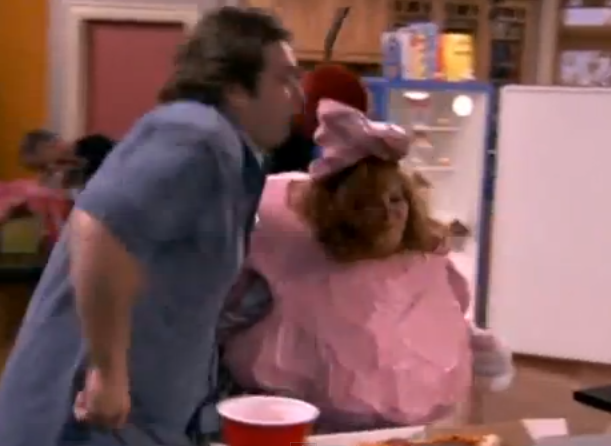
In an incredibly uncomfortable sequence (purposely), Valerie falls in the cupcake suit over and over…finally falling backward, fully knowing she will be in incredible pain afterwards. Who would have ever thought a giant cupcake suit would be such a dramatic prop? After all is said and done, Paulie G insults Valerie one too many time, and Valerie punches him in the gut. Causing him to vomit. Which causes her to vomit. And, in that moment, all the tension that has been building for the entire episode comes to a beautiful, hilarious climax. Because, seriously, who doesn’t love (in the words of Jay Leno) “the rare double vomit”?

What really impressed me was how well Morgan was able to hide the script’s machinations. Every piece of the puzzle was enjoyable enough on its own that it did not seem like set-up, which is the hallmark of great writing.

The series was, in many ways, lightning in a bottle. On every level, from the writing to the cast to the direction, it worked. And that is some kind of special. Of course, “The Comeback” was never planned as a one-season wonder. Though the finale works perfectly as a series finale, when Kudrow came to speak at AFI she spoke at length about what would have happened had the series come back for a second season. Even on the DVD there are extra scenes shot that I can only imagine would have been used if the show came back. Even though I’m heartbroken HBO didn’t give the show a second chance, part of me thinks that it would be nearly impossible to top the first season. Of course, even as I write that, I know that if anyone could do it, it would be Kudrow and King. The character still remains so indelible that I can’t help but wonder where she would be today. What would Valerie Cherish be doing right now? I do wanna see that.

“Valerie Shines Under Stress” is available at HBO Go, YouTube and on DVD.

Monday, February 11, 2013

Arrested Development - "Meat the Veals"


Season 2, Episode 16
Original Airdate: April 3, 2005
Writers: Richard Rosenstock, Barbie Adler
Director: Joe Russo
Executive Producers: Brian Grazer, Ron Howard, Mitchell Hurwitz, David Nevins
Cast: Jason Bateman, Portia de Rossi, Will Arnett, Tony Hale

Telling a single funny joke is infinitely more difficult than telling a single unfunny one, and filling 22 minutes with funny jokes is nearly impossible, no matter what a laughing studio audience would have you believe. “Meat the Veals” is as close to a perfect comedic episode of television I’ve ever seen. Every single joke is funny, and every time I watch the episode I am as entertained as I was the first time. And yes, I write this fully acknowledging that the title is horrible. For me, it’s the pinnacle of “Arrested Development,” a show with many creative peaks.

Plus, there’s Mrs. Featherbottom.

Plus, we’re introduced to Franklin the puppet.

Though now it seems like everyone knows and loves the show (and likes to boast that they watched it when it was originally on air. As if.), the series was an underground movement from the start…the type of program that four hipsters in Brooklyn watched but were afraid to tell others about because it would mean admitting they had a television. Even I, the guy who watched all three episodes of “The Return of Jezebel James,” didn’t start watching until the beginning of the second season. And, truthfully, it’s easy to see why its many eccentricities turned off new viewers. Instead of self-contained, simple A-and-B stories, any given episode had about ten continuing storylines going on. Instead of giving viewers easy jumping-on points for prospective viewers, it filled its half-hours with dozens of in-jokes new viewers would not understand. This craziness is what makes the show great, of course – and are a huge reason why it has flourished on DVD and Netflix (where viewers can watch from episode one and not miss a beat). But for the show’s original audience, the inside-baseball gags were just another reason we loved it. It was like we were part of an elite club that most of the world was not privy to.

Of course being part of a small, elite club watching a broadcast sitcom doesn’t guarantee it’ll have a long and successful run, but that’s beside the point.

The main story of “Meat the Veals” (let me reiterate how much better the episode is than its name suggests) involves George Michael (Michael Cera), to his father Michael’s (Jason Bateman) chagrin, wanting to get pre-engaged to his girlfriend Anne (Mae Whitman). Meanwhile, Oscar (Jeffrey Tambor) wants to throw an anniversary party for his missing twin brother (Tambor again) and Lucille (Jessica Walter). Meanwhile, Tobias (David Cross) has been thrown out of the house by Lindsay (Portia de Rossi) and, in order to see his daughter Maeby (Alia Shawkat), dons the persona of a British housekeeper named Mrs. Featherbottom. Meanwhile, Maeby tries to keep her dual life as a studio exec hidden from her family. Meanwhile, GOB (Will Arnett) wants to re-introduce the family to Franklin, a racist black puppet that mocks George Michael’s “cracker ass,” among other non-bleeped things. Like I said, it’s a little complex for a half-hour sitcom. But then again, half the fun is watching the multiple storylines crash into one another in ways much cooler than “Crash.”

Like I wrote, every single joke lands. Also, this happens, which is my favorite bit of physical television comedy in the past decade. I can’t watch the episode without rewinding Mrs. Featherbottom’s fall multiple times. It’s difficult to pick a favorite bit of dialogue…maybe this one?

Lindsay (re: Mrs. Featherbottom): “You do realize that’s Tobias, right?”Lucille: “If he’s going to get into my closet, he’s going to work for it.”
Or this one?
Mrs. Featherbottom: “Who’s up for a banger in the mouth?”
I’d mention more, but then I’d just start listing, which is only fun if it involves Roger Ebert quotes.

What struck me during this viewing is how varied the actors’ different styles of comedy are. In series like “Fraiser,” and “The Dick Van Dyke Show,” every actor seems to be hitting the same comedic notes in any given episode. Often when a different comedic style is introduced on sitcoms, a’la Urkel on “Family Matters” or Fonzie in “Happy Days,” they tend to take over the show and shift the comedy to their strengths. I don’t write that as a criticism of those shows, just an observation in order to underline how special it is that “Arrested Development” can marry all those brands of humor into one cohesive whole. Cera’s quiet, awkward humor couldn’t be further removed from Cross’ broad slapstick, and yet when they are in the same room together, it feels right.

This leads me to the question of whether this is the best comedic ensemble in television history. Surely the casts of shows like “I Love Lucy,” “Seinfeld” and “The Mary Tyler Moore Show” were, in their own ways, perfect…but this cast is also perfect. And bigger. And while those sitcoms ostensibly had the title star at their center, here there is no true lead. Yes, Michael is our way into the show, but in many ways he’s just as demented as the rest of his family (it’s just not as obvious) – and just because you play the straight man in a comedy sketch does not mean you are central to it. So yeah, as to the question posed above, I’ll call this troupe the once-in-a-lifetime, lightning-in-a-bottle, other-clichĂ©-chesnut, best cast in the history of television.

And I’m so happy that “Arrested Development” has crossed over garnered the popularity it always deserved. I remember being in college when I discovered it, and putting on DVDs of the first season for my friends while we were eating Papa Johns and whipped ice cream. In a way, helping others discover the program and the greatness contained therein was part of the fun – like handing a great novel to someone and whispering “you’ll thank me later.”

“Meat the Veals” is available on DVD, Netflix, Amazon Prime, iTunes and Hulu. And now, seven years after the show was cancelled midseason by Fox, it has been revived by Netflix. The fourth season will be available in May.

Monday, October 29, 2012

Studio 60 on the Sunset Strip - "Pilot"


Season 1, Episode 1
Original Airdate: September 18, 2006
Writer: Aaron Sorkin
Director: Thomas Schlamme
Executive Producers: Thomas Schlamme, Aaron Sorkin
Cast: Matthew Perry, Bradley Whitford, Amanda Peet

The teaser of the first episode of “Studio 60 on the Sunset Strip” feels like a sledgehammer to the chest. It’s one of the most powerful, impactful openings of any series, and possibly the best. Writer Aaron Sorkin and director Thomas Schlamme were obviously inspired by the classic film “Network” (and say as much later in the show), but for my money this sequence transcends the movie. It’s so awesome, in fact, that the good will it builds allows Sorkin to take some major chances with structure and character development throughout the remainder of the episode.

The show focuses on the Los Angeles equivalent of “Saturday Night Live,” a live sketch-comedy show called “Studio 60.” Exposition is set up beautifully in the first few seconds as show cast member Simon Stiles (D.L. Hughley) informs the studio audience (and, by proxy, the viewers) about the history of “Studio 60,” the studio and how live television works. But then we begin to realize that the show is past its heyday, and the thousands of small stresses and sacrifices creator/head writer Wes Mendell (Judd Hirsch) has made finally cause him to have a nervous breakdown. By walking out on set. Live on air. And going into a rant about the slow disintegration and bastardization of the television industry.

That is all great, but what takes the sequence to another level is that we cut between the rant and the show’s director, Cal (Timothy Busfield) making the decision to keep Wes on air as long as possible, despite network executives screaming at him some variation on “you’ll never work in this town again!” Both threads are equally gripping, but the back-and-forth editing perfectly showcases the escalating chaos, climaxing with a smash to the show’s intertitle at the moment Cal finally gives in and cuts away from Wes, leaving the viewer gasping for air. Now that’s how you cut to commercial.

From here on in, Sorkin begins to play with the structure of most television pilots. The two main characters, Matt (Matthew Perry) and Danny (Bradley Whitford) don’t even appear until 20 minutes in. Instead, Sorkin uses the time immediately following “the event” to focus on new network executive Jordan McDeere (Amanda Peet) as she deals with the fallout on her first day of work (technically she doesn’t even have to start work until the following Monday, but decides “what the hell?”) and butts heads with another executive, wonderfully played by Steven Weber.

Jordan, along with Peet’s interpretation of the character, is one of the most fascinating, refreshing parts of the series. Peet was attacked by many critics for her “romantic-comedy” take on the roll, but I think that criticism is woefully misguided. The easy route would have been for Sorkin and Schlamme to cast an uptight “bitch” type for the role, but instead they did something much more interesting: They cast Peet against type and had her just act like a smart, normal woman doing her best in a bad situation. Instead of dealing with the dozens of lesser executives all looking at the mess on a micro level she sees the macro version of the problem. She doesn’t want to keep plugging the dam, she wants to build an entirely new one, and goes out of her way to accomplish that by being honest and forthright, two values none of the other characters seem to believe or, hell, can even comprehend in the television industry. When she tells Danny she knows he had cocaine in his system, he immediately believes she’s trying to blackmail him when that couldn’t be further from the truth. Whoops. Because she’s so forthcoming and honest, I’m guessing that’s why critics’ gut was that Jordan was underwritten, when it couldn’t be further from the truth.

Sorkin’s writing throughout is sharp, and his script never talks down to the audience. When there might be exposition that goes over our heads, he finds ingenious ways to make it come through without seeming like exposition, like Simon’s aforementioned introduction to the audience. His now-famous Walk-and-Talks conversations remain a thing of beauty, and many of his recurring storytelling tics pop up again here and are used well.

Many of his storytelling techniques bleed freely from one series to another. Turn on any Sorkin show and you’ll be likely to find two soul mates working in the same place who just can’t quite admit to themselves that they love one another (Casey and Dana on “Sports Night,” Will and Mac in “The Newsroom,” Matt and Harriet here). There’s usually an evil boss character who we later learn isn’t all that bad (Weber here, Jane Fonda on “The Newsroom,” William H. Macy on “Sports Night”) and loads of conservative characters (Will on “The Newsroom,” Harriet here) who serve as soapboxes to preach or be preached to. Oh, and he borrowed the opening nervous breakdown from “Studio 60” for the opening of “The Newsroom.” I mention these not as criticisms, but as observations. He goes back to these watering holes because they usually work well and he manages to find fun variations each time he does it.

Another thing Sorkin often gets criticized for is the lack of realism in his shows, which I find ridiculous. Just because his shows use real-life news events and politics as the backdrop for the storytelling does not mean that they must be gritty and real. Look at the pilot to “Studio 60,” where anchors on every cable news channel not only mention that the rant came from “Network,” but name check its writer, Paddy Chayefsky. As a screenwriter, it’s nice to think that might happen, but seriously? In what world? And his characters, despite speaking eloquently about politics, owe much more to the screwball comedies of the ‘30s and ‘40s (“Bringing Up Baby,” “His Girl Friday”) than reality. And, no offense to the gritty/shaky-cam/dark/topical/whatever shows, that’s the way I like it. If I’m being preached to, I want some escapism and I want some hope.

Over the course of its 45 minute pilot, “Studio 60 on the Sunset Strip” manages to create an entire world, populate it with a diverse, multi-dimensional cast and then topped it all off with a Queen song for good measure. It remains one of the most literate, engaging hours of television I’ve had the pleasure of watching. Screw what the critics say.

The pilot of “Studio 60 on the Sunset Strip” is available on the Complete Series DVD, Amazon Instant Video and iTunes.

Wednesday, October 17, 2012

Popular - "Two Weddings and a Funeral"


Season 1, Episode 22
Original Airdate: May 18. 2000
Writer: Ryan Murphy
Director: Lev L. Spiro
Executive Producers: Ryan Murphy, Gina Matthews, Michael M. Robin, Greer Shepard
Cast: Leslie Bibb, Carly Pope, Leslie Grossman, Tammy Lynn Michaels

“Popular” was a teen drama on The WB that quickly morphed into a send-up of teen dramas on The WB. At first it seems to present viewers with all the storylines one would expect from such a show (pregnancy, addiction, losing your virginity etc.), but then twisted the telling while consistently winking and nudging the audience that the creators were in on the joke. By the time the show reached its first season finale, “Two Weddings and a Funeral,” the creators didn’t even try to be subtle about it anymore.

The episode opens with a character musing: “I love the merry month of May, except for those ridiculous sweep cliffhanger stunts they always pull on my favorite teen dramas.” She then lists every possible sweep stunt, including the wildly silly ones:
  • A Wedding
  • Pregnancy
  • Death
  • Natural Disaster
  • Appearance by a Cheesy Boy Band
  • Pretty Boy Nudie Shot
  • When Pets Attack
  • Gratuitous Musical Number

The episode then goes out of its way to include all of the above. The episode’s writer, Ryan Murphy, went out of his way to string together a seriously cuckoo-for-Cocoa-Puffs series of events for his cast to deal with in one episode, not just making the show meta, but then piling meta on top of the meta. For weeks leading up to the finale, The WB was advertising the “Popular Purge,” which was the killing off of a major character on the show. During the finale, viewers could post on the show’s message board and their opinions on who should die and why were blipped across the bottom of the screen. Of course today, with everyone tweeting and twatting their every thought, talk show hosts regularly pretending viewers’ tweets are just as valuable as experts, and networks helpfully putting some variation on “#posthowawesomeweare” at the bottom of their screen at all times, the stunt seems less impressive…but during its initial broadcast I remember giggling (yes, giggling) with delight.

The storyline…well…is a clusterfuck, and by that I mean absolutely brilliant. Let’s see if I can keep it straight. On Sophomore Skip Day, wicked chemistry teacher Bobbi Glass (Diane Delano) sends her class’ photos to every hangout in the city so they will be arrested for truancy if they show up. To get her back, they lace her milkshake with e. coli. She doesn’t drink it, but seconds later becomes paralyzed by her twin sister, Nurse Jessie Glass (Delano again), who wants to kill her after making her suffer through being eaten alive by her cats, then frame the kids. All the while, Brooke (Leslie Bibb) and Sam (Carly Pope) frantically try to keep everything under control while they prepare for the wedding of their parents. Oh, and Mary Cherry’s (Leslie Grossman) mother Cherry Cherry (Delta Burke) will be marrying Erik Estrada (not kidding) at the same ceremony. Oh, and because of eating too much dirt, Mae Tuna (Mandy Freund) needs a heart valve transplant or she’ll die. Oh, and there is a voodoo witch doctor. Oh, and Brooke and Josh (Bryce Johnson) might be getting back together. At one point Sam tells Brooke:
“You guys are hilarious. You’re like the typical TV show couple who breaks up, gets back together, breaks up and gets back together one last time on the last show simply for promotional sweets purposes.”
The amazing thing is, during all this madness, Ryan never loses track of his ensemble. More than that, he uses them quite well. In an age when most network shows are populated by interchangeable babes and hunks saying interchangeable dialogue on interchangeable sets, every main character her has a point-of-view. There are several big sequences that involve the almost the entire ensemble arguing and babbling over one another, and I couldn’t help but grin because, in each scene, each character comes to the situation from his or her own perspective. Nicole Julian (Tammy Lynn Michaels) just wants to get out of the situation, even if it means framing Sam. Sweet Lily (Tamara Mello) immediately feels horrible about the group’s actions and turns the murder plot into a moment to preach about teachers being underappreciated in our society. And lunkhead Josh is just thinking about what to write in Brooke’s yearbook.

And then there’s Mary Cherry. Introduced as a popular Southern belle supporting character, Mary Cherry (she’s never called just Mary) proceeded to take over the “Popular,” with Grossman’s incredible humor and comedic timing something Murphy and his writers seemed to love tapping into. She had webbed hands and feet. She had a surprise twin sister named B. Ho. She carries around a vial of e. coli virus in her purse because, “A girl never knows when she’ll have to lose the odd fifty pounds.”

And then there’s the dialogue. This episode has more one-liners that actually land than any given episode of your traditional sitcom. When Nicole Julian arrives at Brooke’s home carrying Ms. Glass’ stray finger, she says:
“Mary Cherry, put the finger in the fridge. Bring me a Diet Coke.”
When Ms. Glass is threatening her students she boasts that:
“After a nuclear apocalypse, I’ll be the only thing standing other than the cockroaches and Cher.”
Though the second season of the show had many sterling episodes (most notably “The Brain Game” and “Baby, Don’t Do It”) it was obvious that The WB heads didn’t like being poked fun at and put pressure on the writers to normalize with traditional teen soap storylines sans the added twists. Harrison got cancer. Lily and Josh got married and cried way too much. The balance felt…off.

And yet “Popular” was still better than almost every other teen drama on television, and certainly better than most of the sitcoms. It remains a touchtone for me and is one of the reasons I wanted to become a television writer. The balance of humanity, humor and meta-commentary on the television industry found in this episode has never been equaled or surpassed by any show before or since. Plus, did I mention Mary Cherry rocks?

“Two Weddings and a Funeral” is available on the first season DVD of “Popular” and on YouTube.

Saturday, September 22, 2012

Masters of Horror - "John Carpenter's Cigarette Burns"

Season 1, Episode 8
Original Airdate: December 16, 2005
Writers: Drew McWeeny, Scott Swan
Director: John Carpenter
Executive Producers: Mick Garris, Keith Addis, Morris Berger, Steve Brown, Andrew Deane, John W. Hyde
Cast: Norman Reedus, Udo Kier, Zara Taylor


“Film in the right hands is a weapon.”
A character intones this in “Cigarette Burns,” and after watching the violence caused by “The Innocence of Muslims” and the domino effect that continues, my mind kept drifting back to this episode of “Masters of Horror,” in which an evil film becomes a cause for pain, torture and riots. Here is an episode of television with gigantic, far-reaching ambitions that just exceed the grasp of the filmmakers creating it – but watching them try to pull it off is some kind of wonderful.

When I say the movie in “Cigarette Burns” is evil, I don’t mean it in the same manner I do the inept and disgusting “The Innocence of Muslims.” The film in question, “La Fin Absolue du Monde” (translated to “The Absolute End of the World”) is actually evil. It depicts, among other atrocities, an angel having its wings savagely torn from its body. We learn that there was only one screening, at a festival in the ‘60s, where the audience rioted and attacked one another until the aisles were slicked with blood. After that, it seemingly disappeared into the ether.

Kirby (Norman Reedus), a film historian who has a reputation for being able to find any lost film, is hired by a rich man named Bellinger (Udo Kier doing a great Peter Lorre impersonation) to track it down. Bellinger is obsessed with “La Fin Absolue du Monde” and has several props from the film: The pair of wings torn from the Angel framed on his wall…and the Angel trapped in chains in his basement. Kirby is a recovering junkie who recently lost his love Annie (Zara Taylor) and takes the job because he owes a lot of money to Annie’s father (Gary Hetherington). He’s already emotionally fragile from his loss – and from the moment he begins his pursuit we can tell he is going to fall into the same cycle of obsession Bellinger cannot escape from.

Kirby seeks out to find information about “La Fin Absolue du Monde” from several people, and we make the quick realization that any person even slightly associated with the missing film has been mentally (or, in some cases, physically) destroyed. Hell, the director, Hans Bakovic, has also seemed to disappear completely. Most memorable among those Kirby can track down is an audience member (Chris Britton) from the first screening who has spent decades attempting to pen a worthy review of the film, writing tens of thousands of pages in the process. Surrounded by the pages, he speaks in a horrifyingly calm tone to Kirby:


“We trust filmmakers. We sit in the dark, daring them to affect us, secure in the knowledge that they won’t go too far…Hans Bakovic is a terrorist. He abused that trust we place in filmmakers. He didn’t want to hurt his audience – he wanted to destroy them completely.”


More than that, the film is physically manifesting itself for Kirby the closer he gets to it. He begins seeing “cigarette burns,” those circles you see at the top of a film frame when you’re at the movies that signals it’s time to switch reels, and though he keeps telling others that he doesn’t want to see the movie, we know he won’t be able to escape it.

The co-writers, Drew McWeeny and Scott Swan, have set up an incredible concept (the horror version of “Raiders of the Lost Ark” in many ways) and beautifully build suspense throughout the episode. There are many scenes where characters say some version of “This movie is fucking evil,” but McWeeny and Swan manage to find interesting variations and ways to continue the escalation. John Carpenter, who also directed the film masterpieces “Halloween” and “The Fog,” is expert in maintaining tension and his touch is apparent throughout, despite an over-reliance on gore that became both a hallmark and problem for most of the “Masters of Horror” episodes. Particularly out of place is a scene where Kirby is tied to a chair and must witness a psychopath (driven mad by the film, of course) behead a woman by repeatedly chopping into her neck with a machete. The scene feels exploitative and done because the audience expects it more than because it serves the story. It also doesn’t work on a technical level – the psychopath makes a point of talking about how powerful a murder would be if shot in a single take, but what power the moment might have is undercut by the editor’s constant snipping.

Kirby finally gets his hands on “La Fin Absolue du Monde” and here is where “Cigarette Burns” stumbles, but that’s not to say there aren’t thrilling moments in the climax. It’s just that, unfortunately, the writers did such a fantastic job of building to the moment that nothing could possibly live up to the viewer’s expectations. Carpenter unwisely made the decision to actually show sections of the “La Fin Absolue du Monde” instead of just letting our imaginations do the work, and that stops the episode dead in its tracks. One scene looks like something from “The Blob,” and the others are nothing we couldn’t see in any “Saw” or torture-porn flick. In many ways it is reminiscent of the third-act problems with Carpenter’s near-masterpiece “In the Mouth of Madness,” where he literally found himself written into a corner (those who have seen the film will get the pun).

But there is great stuff in those final moments. Bellinger’s butler has such a visceral reaction to seeing the film that he stabs both his eyes out. Bellinger falls deeper into madness and actually tears out his small intestine and begins running it through the projector, which is one of the most disturbing/amazing death scenes ever placed on film. And the final beat, with the Angel taking back the film and escaping from the destruction, is rightly moving.

By naming his show “Masters of Horror,” Mick Garris set an impossible standard for his anthology series. He did recruit some of the best names in horror: Carpenter, Joe Dante, John Landis and Dario Argento, among others, to direct the episodes but, as with most anthologies, the episodes vary widely in quality, with many way too gory for their own good (even the Masters often forget that more blood doesn’t automatically equal more horror). One episode in particular, “Imprint,” (directed by Takashi Miike) involved so much blood, gore and aborted fetuses that even Showtime found it too disgusting to air. But several, like “Cigarette Burns,” Dante’s “Homecoming” (a brilliant dark comedy where all the soldiers who died in Iraq raise from their graves…to vote against George W. Bush) and Landis’ “Family” (in which a deranged family man wants to murder his neighbors and adopt them into his home) are genuinely awesome. After two seasons on Showtime the show moved to NBC with a new title, “Fear, Itself” and leveled out in quality right before its cancellation.

I love “Cigarette Burns” for what it aspires to be, and it is one of the few modern horror works that actually got under my nerves and affected me on a visceral level. At its very best (or very worst), film and television can affect a viewer deeply in a manner no other artistic outlet can, which can be both lovely and horrifying, depending on your perspective.

“Cigarette Burns” is available as an individual episode onDVD or as part of the “Masters of Horror” season one boxed set. It’s also available on iTunes and on Hulu.

Sunday, August 12, 2012

Alias - "Phase One"

Season Two, Episode 13
Original Airdate: January 26, 2003
Writer: J.J. Abrams
Director: Jack Bender
Executive Producer: J.J. Abrams, Ken Olin
Cast: Jennifer Garner, Michael Vartan, Victor Garber, Carl Lumbly

When television shows reinvent themselves, it is usually because producers or the network think that the storytelling has gone off course or stagnated…or because a popular actor is leaving his or her role. You rarely see it done on a “healthy” show. Sure, shows like “24” claim to hit the reset button every season, but then a mole always shows up in CTU and Jack ends up in handcuffs again. Off the top of my head I can think of the “Two Fathers/One Son” episodes of “The X-Files” that brought to a head six years of complex mythology, Roseanne’s family winning the lottery and the complete creative makeover of “The Practice” in its final season before it transformed into “Boston Legal.” And then there is “Phase One,” which feels for most of its running time like a series finale before upending our expectations and setting the stage for a completely revamped version of “Alias.” The show would pull a similar change-up at the end of this season and several other times during its five-season run, but “Phase One” remains the best of the bunch and one of the most engaging episodes of adventure television ever produced.

Up until this point, the series focused on secret agent Sidney Bristow (Jennifer Garner), who believed she was working for the CIA until they killed her fiancĂ©. She then realized she was working for a terrorist cell called SD-6 and became a double agent, working with the real CIA to take down SD-6 with her father Jack (Victor Garber), who was also a double agent. Also, Sidney’s mom had shown up and there was all this stuff about a dude named Rambaldi and a floating red ball filled with water and Francie (Merrin Dungey) had just opened a restaurant. Phew.

When you consider the circumstances surrounding the production of this episode, it’s a miracle it’s even comprehensible—let alone awesome. You see, “Alias” was chosen to be the show that immediately followed the Super Bowl. This was an opportunity for showrunner J.J. Abrams (who also wrote the episode) to attract a lot of new eyeballs, but getting those viewers up to speed on the complex mythology (see above) and who is who was not exactly an easy task. Instead of just making the episode a jumping-on point, which was the logical thing to do, Abrams instead decided to get viewers up to speed on the mythology…and then blow it up by the end. All in a 42 minute running time.

Shockingly, Abrams pulled it off with a lot of style and still manages to insert several beautiful character moments that had become a hallmark of the series. Turns out the guy is pretty good at this kind of thing—think of his reboot/sequel “Star Trek,” (which was co-written by “Alias” writers Alex Kurtzman and Roberto Orci), which boiled down decades of “Star Trek” mythology to its essentials while still telling a coherent, enjoyable story that could attract new viewers.

The black one.
Apparently eager to ensure male viewers would stick around, the episode opens with Sidney on a private plane strutting her stuff in black underwear…then re-strutting it in red underwear. The camera lingers on her assets in an almost exploitative manner (while AC/DC plays in the background, no less!), but Abrams and his director Jack Bender almost immediately upend this male-fantasy by having Sidney kicking the ass of the guy oogling her (“What was wrong with the black one!?” she hisses as she strangles him, before continuing, “You think it’s comfortable wearing clothes like this?”). There’s a fight scene that leaves Sidney in mortal jeopardy and then we flash back one day earlier.


The red one.
Even though series supervillain Arvin Sloan (Ron Rifkin) is mostly M.I.A. here, Abrams introduces a new, wonderful baddie named Geiger, played by Rutger Hauer, who has been inserted as acting director of Sidney’s branch of SD-6. As if having The Hitcher in the episode wasn’t enough, there’s also a cameo by The Tall Man (Angus Scrimm) as a computer expert. “Alias” was a show unafraid to showcase its geek roots, and also had small roles for such greats as Quentin Tarantino and David Chronenberg.

Admittedly, the plot centers on a deus ex machina. All of the information needed to take down SD-6 just happens to be aboard the plane we see Sidney fighting in during the opening sequence. But Abrams does a fantastic job of dressing up the deus ex machina so well you barely even notice. First there is the aforementioned playing with time, then the ticking-time-bomb aspect to the information that can only be solved by Sidney admitting everything to her best friend in SD-6, Dixon (Carl Lumbly), because he has to send a confirmation code to the CIA in order for them to take down the enemy. Got all that?

The scene where Sidney tells Dixon that his entire life is a lie hits you like a punch to the gut, and rightfully so. In the pilot, we weren’t as emotionally invested in Sidney’s realization because we barely knew her as a character, but here the weight of the revelation is given time to sink in. Abrams even allows time for Dixon, convinced he may die that day, to call his wife to tell her he loves her. The emotional stakes are much higher than just Dixon’s arc, though: Jack is discovered to be a double agent, kidnapped and tortured at length by Hauer’s character to see who he is working for. There’s another beautifully written small scene where, in the midst of the torture, Jack tells Geiger that they actually had dinner together one night, and they laugh as they share memories of the moment. It’s completely throwaway but humanizes Geiger (who until this point has come off as oily as Lex Luthor) and makes us root for Jack all the more.

And then there’s the action. The episode’s centerpiece is indeed the plane sequence, and when it’s revisited halfway through, the tension escalates until Sidney is forced to blow out the side of the plane, cause it to crash and manages to jump out of it with a parachute at the last moment. The set-piece looks and feels very expensive (the CGI work is feature-worthy), and seems like a sly tip-of-the-hat to the climax of “Goldfinger.”

Oh, and Sidney also makes out with Vaughan (Michael Vartan).

Oh, and Francie is killed and replaced with an evil identical version.

That’s one hell of a lot for one episode, and most of what Abrams does is directly against everything television writers are taught. You are never supposed to change the premise of the show so much that it becomes unrecognizable. You are never supposed to get your will-they-won’t-they couple together before the series finale. And this especially should not happen only halfway through the season. But if all this is so wrong, then why does it feel so right?

“Phase One” is available on the second season DVD of “Alias” and on Youtube. Sorry, no Hulu or iTunes this time.