Showing posts with label Death. Show all posts

Wednesday, March 20, 2013

Dallas: “A House Divided”


Season 3, Episode 25
Original Airdate: March 21, 1980
Writer: Rena Down
Director: Irving J. Moore
Executive Producers: Philip Capice, Lee Rich
Cast: Larry Hagman, Patrick Duffy, Linda Gray

The first thing to note about “Dallas” is how big it is. Those opening credits, with the sprawling theme music and helicopter shots of the city and South Fork, present the viewer with an introduction to the biggest poker table in the world. Everything is up for grabs – all you have to do is want it enough and not be afraid to get a little blood on your hands. It feels like a big-budget movie, not an episode of television.

It’s a shame that the series is remembered today more for its cuckoo-for-Cocoa-Puffs stunts more than its excellent storytelling. I came to this series after becoming a fan of the fantastic sequel show, which underlines that a good soap opera does not have to be done with camp or over-the-top slap-fights. In many ways, it’s more difficult to write a good, character-based soap than many other genres – here, all the drama must come from within while still allowing the characters to grow, mature and revert.

“A House Divided” presents us with the most memorable season-ending cliffhanger of all time: Who shot J.R.? J.R. (Larry Hagman) is ultimate villain – viewers loved to hate him just as much as “Dallas’” characters simply hated him.  The episode opens with J.R. having pulled off the neat hat-trick of managing to save his company from going belly up while systematically bankrupting almost every other oil baron in Dallas. I’m not exaggerating by writing that the first ten minutes of the episode involve character after character entering J.R.’s office, threatening him and then leaving just in time for the next character to come in and start screaming.

But then again it isn’t like his home life is going much better. He’s attempting to get his alcoholic wife Sue Ellen (Linda Gray) institutionalized. I’m not an expert on the mythology of the show, but I have a feeling J.R. probably drove his wife to the bottle, and I can’t really blame her. His mistress is trying to backstab him. Even his dear ‘ole Mama Miss Ellie (Barbara Bel Geddes) is cross with him after J.R. manages to drive Bobby (Patrick Duffy) away from Southfork. Sure, Miss Ellie seems soft on the surface, but anyone who watches “Alfred Hitchcock Presents” knows she is not one to be trifled with.

And let’s not forget the reason Bobby decided to leave Southfork. Ewing rival Cliff Barnes (a wonderfully oily -- sorry for the pun -- Ken Kercheval) has found legal documentation that he is entitled to half the profits from a hugely profitable oil field. J.R.’s response to the news? He immediately shuts down the wells and refuses to turn them back on. Sure, this screws him out of millions in profits, but he wins, so whatever. When Bobby finds out, he’s livid, and responds by wanting to get himself and his wife as far away from J.R. as possible.

Sure, you can see the machinations of the plot twisting in every scene of the episode, but that does not mean the writing is not inspired. The episode (and the series as a whole) is all about those machinations, and it feels like a more fanciful version of “Dune,” with oil substituted for the spice. And yes, that was sarcasm. J.R. seems to have the ability to be completely emotionless about his shady dealings, snaking back and forth whichever way he needs to, damn the consequences for everyone around him. He appears to think that everyone capable of decency is really “weak.” He never seems to ask a question, only make statements that he treats as facts, no matter how insane they are. In other words, he’s a monster. In an odd way, it becomes fitting that an act of emotional rage is what brings him to a halt (albeit only for a little while).

As terrible as J.R. is, I can see why he became so beloved: He’s the only one on the show unafraid to crack a smile. Everyone else on “Dallas” has their emotions cranked up to an 11 at all times, but J.R. spends at least as much time coming up with wisecracks as he does plotting the downfall of [Insert Character Here].

Take this line, said to his mistress:
“It takes brains to know when to be scared, honey, and since that’s something in short supply around here, I’m gonna help you. Now is the time to be scared.”
Or this exchange with his wife:
Sue Ellen: “Tell me, J.R., what slut are you going to stay with tonight?”J.R.: “What difference does it make? Whoever it is has got to be more interesting than the slut I’m looking at right now.”
The aforementioned scene where Bobby lets Miss Ellie know that he’s going to leave is surprisingly poignant, a reminder that sometimes morality and honesty can be just as engaging and powerful as villainy. Duffy is excellent in the loud and emotional scene, and it proves why his character is such a great foil for J.R.

The dynamic of the series at this point seemed to be a great triangle of power between Bobby, who represented good, J.R., who represented evil, and their father Jock (Jim Davis), who was the pendulum that swung between the two. That triangle is echoed on the new show in a similar way, with Cliff Barnes’ family representing evil, Bobby’s family representing good and J.R.’s brood representing the pendulum.

Yes, there’s one or two “I’ll kill you for this, J.R.!” too many peppered into the episode, but I’m surprised it holds up as well as it does today. When you hear so many times how campy and over-the-top these ‘80s soaps were, then see those shoulder pads, then watch this compilation video, you begin to believe that they were horrible. And yet “A House Divided” is tightly scripted, the characters are memorable and that cliffhanger still packs a punch. And did I mention that theme song? Wow.

“A House Divided” is available on DVD and iTunes. The “Dallas” sequel series is on TNT Mondays at 9 p.m.


Monday, March 4, 2013

Thriller - "Pigeons From Hell"


Season 1, Episode 36
Original Airdate: June 6, 1961
Writer: John Kneubuhl (adaptation), Robert E. Howard (original story)
Director: John Newland
Producers: William Frye, Maxwell Shane
Cast: Brandon De Wilde, Crahan Denton, David Whorf, Boris Karloff

“Pigeons From Hell” is a masterpiece of slow-burn horror. At first glance, its creators seem content to embrace all the usual trappings that are trotted out to achieve cheap, impact-less scares. But instead of the cheap scares, we are instead treated to slow tension building over the course of the hour, deliberately paced to get under the viewer’s skin and linger there.

Tell me if you’ve heard this one before: Two brothers (Brandon De Wilde and David Whorf) find their car broken down on an abandoned highway in the middle of nowhere. They come upon a nearby abandoned mansion… and then the horrors begin to happen. But instead of a bunch of scares straight out of the Universal B-horrors of the 1940s, writer John Kneubuhl and director John Newland aim to create the best movie Val Lewton never produced. It is an adaptation of a great short story by Robert E. Howard (a writer who inadvertently was the cause of Arnold Schwarzenegger’s career by creating “Conan the Barbarian,” but don’t hold that against him), and in his adaptation Kneubuhl makes two distinct but very smart changes.

In the original story the young men are just friends, but here they are brothers. When Whorf’s character gets an ax to the skull, there is much more emotional resonance for both the audience and De Wilde’s Timothy. The original story worked fine without it, but here it gives the death extra significance, especially considering we only have five minutes with the characters before one is murdered.

Second, the short story takes place over the course of two or three days and nights, but Kneubuhl condenses the story to a single, endless night of horrors. That way the atmosphere is relentless – the characters cannot escape the dark and neither can we.

The most overt horror in the episode comes early: The aforementioned ax murder. While his brother sleeps, Whorf’s Johnny is drawn up the stairs of the deserted mansion by ghostly singing. When Timothy goes searching, he finds Johnny’s skull cracked in two. But that doesn’t make Johnny any less mobile – his brains still bleeding all over, Johnny chases Timothy out of the mansion, waving about the ax that was used to kill him. Despite the grisliness of what I have just described, the scene is played almost entirely by suggestion. While Johnny stalks Timothy in the hallway, we never actually see the split skull or the brains… all we see are drops of blood streaming down the front of his face. Everything else is hidden by the shadows.

Timothy manages to make it a few hundred yards away from the mansion before passing out. He is brought to the nearest Sheriff (Crahan Denton) by a town hick, and when the Sheriff decides to take the boy back to the mansion to investigate, we get the single inadvertently funny moment of the episode: The hick busts out of the house they are in and rushes off into the nearby woods like the Roadrunner escaping the Coyote. De Wilde, who many will remember for saying “Shane!” a thousand times in the film classic, also has the task of attempting to explain what happened to him in the mansion while being overcome with grief for his brother, and though his line readings might come off as hackneyed in another film, his innocent looks and inability to properly articulate himself actually works in favor of the character.

The Sheriff takes Timothy back to the mansion to investigate, and instead of a bunch of boo-scares and chains rattling, Newland provides viewers with a single, indelible image. Every time the duo enter the room where Johnny died, their kerosene lantern will not stay lit. The moment they exit the room, it comes back on. Any fan of a good horror movie knows the darkness is much scarier than seeing what is in the darkness, and that is never more obvious than here. Also, because there are no silly noises or faux-climaxes in the sequence, the viewer is consistently on the edge of his seat. There is no end to the tension until they leave the house – the threat of something bad happening ensuring the viewer cannot relax.

The atmosphere is only aided by the black-and-white cinematography, shot by Lionel Lindon (who also shot the incredible “The Manchurian Candidate” and the minor noir classics “Whirlpool” and “The Blue Dahlia”). I doubt there’s a shot in the film where everything in a given set is fully lit. Lindon uses the shadows to play with our expectations of terror, especially considering a character says early that the swampland is crawling with snakes. The lighting also makes some old-man makeup that would doubtless look hackneyed in color into something downright creepy.

Kneubuhl and Newland approach the episode’s climax with the same slow-burn mentality, refusing to ratchet up the pace for no good reason. As a result, Timothy’s slow, zombie-like walk up that decrepit staircase toward his destiny becomes excruciatingly suspenseful.

It's all about those eyebrows.
I got the “Thriller” boxed set for Christmas this year and have been consistently surprised at the quality of the episodes. It’s the only hourlong anthology series I’ve seen thus far that makes good use of its entire running time (unfortunately, “The Outer Limits” often feels like a half-hour show stretched to its breaking point to fill its hour) on a regular basis. I’ve watched about half the series (the first season is 37 episodes, so it’s not like I’m being lazy) and find that even the lesser episodes are still of legitimate quality, and Jerry Goldsmith’s musical scores are feature-film worthy, even eclipsing Bernard Herrmann’s scores for “The Twilight Zone.” The show pays homage to the Universal classic horrors of the 30s, especially with its use of host Boris Karloff (whose eyebrows here are epic, matched only perhaps by Larry Hagman’s in the “Dallas” reboot), but takes most of its inspiration from Lewton’s horror films of the 40s. Still, every now and then you can see the viciousness of the 50s Hammer films sneaking in. Since I love all those eras of fright, I feel like a kid in a candy shop every time I insert a new disc. “Pigeons From Hell” is my favorite, but I could have easily chosen “The Grim Reaper,” “Parasite Mansion,” “Late Date” “The Hungry Glass” or “The Purple Room”…and that’s just from the first season. It’s such a shame this show doesn’t exist in the public consciousness in the same way “The Twilight Zone” or “Alfred Hitchcock Presents” does, because it certainly deserves to be.

“Pigeons From Hell” is available on DVD and YouTube.

Monday, February 25, 2013

Southland - "Graduation Day"


Season 3, Episode 10
Original Airdate: March 8, 2011
Writers: John Wells (teleplay), Heather Zuhlke (story)
Director: Christopher Chulack
Executive Producers: Christopher Chulack, John Wells
Cast: Ben McKenzie, Regina King, Shawn Hatosy, Michael Cudlitz

For a show whose survival has been nothing short of miraculous and whose storytelling is consistently brilliant, “Southland” never seems to get the respect it deserves. Everyone I’ve recommended the show to doesn’t seem to know it exists or thinks its been long-cancelled, and yet when they actually watch an episode they end up addicted. And while I came close to choosing the nearly-flawless pilot for this article, “Graduation Day” represents the show at its creative peak, and part of what makes this episode special is that it should not logically exist.

The premise of “Southland” is as simple as they come – it follows the day-to-day lives of a handful of Los Angeles police officers and detectives. No huge meta twist, no quirky detective protagonist…just real people trying to stay above water while doing one of the most emotionally taxing, physically dangerous jobs on the planet. It premiered on NBC as a midseason replacement to decent ratings and was renewed for a second season shortly thereafter.

Then the great NBC Jay Leno experiment came into play.

For those unfamiliar, for a season NBC wiped all original programming from their 10 o’clock hour and replaced it with a Jay Leno talk show that premiered to huge ratings but then quickly floundered. Because of “Southland’s” dark content, NBC’s executives allegedly became very uncomfortable with airing it at 9 p.m. and cancelled it before it even had a chance to premier, with six episodes already filmed.

TNT, a network known more for “The Closer” than for gritty, realistic drama, swooped in and agreed to air the six unaired season two episodes. Then, miracle of miracles, the network picked it up for a third season of ten episodes with a much-reduced budget…and the results are some of the best television I have ever seen. It’s not often that a show has a “perfect” season, and even now I can count them on a single hand…but, to me, the season is just about as perfect as they come. The show seemed to flourish under the budget cuts, taking more chances and finding inventive (and often heartbreaking) ways to trim its cast. The storytelling was more honest and streamlined – and now the show is in the middle of its fifth season. All with a fraction of the critical acclaim lavished on shows like “Girls” or “Boardwalk Empire.”

But back to “Graduation Day” which, despite being the third season finale, is only the 23rd episode of the series. The brilliant John Wells (who helped to craft such masterworks as “The West Wing” and “E.R.”) wrote the script based off a story by Heather Zuhlke, and together they paid off storylines that had legitimately been building since the first episode of the series. I’m guessing that they went into the episode assuming that it would be a series finale, which is why there is an added sense of urgency to almost every scene.

The theme of the hour, underlined by its title, is one of transitions for every cast member. Ben (Ben McKenzie) is graduating from boot cop. Cooper (Michael Cudlitz) finally must face his painkiller addiction head on. Sammy (Shawn Hatosy) finally catches the scum who murdered his partner and welcomes his son into the world. Chickie (Arija Bareikis) is moving on from her partnership with Dewey (C. Thomas Howell), who doesn’t know how to deal with it. And Lydia (Regina King) explodes the finally stable relationship she has with her partner.

As with any episode of “Southland,” it’s all about the moment-to-moment encounters these officers have and how those small beats build up to a cohesive whole. A career. A life. In a scene that could easily have come across as throwaway, Ben and Cooper are called to a house where a mother is livid that her husband allowed a gang symbol to be tattooed on their six-year-old son. The scene plays almost comically at first, but then we see the young boy point his finger at Cooper repeatedly and pretend to be shooting him. And suddenly, our hearts break. We understand the struggle they go through and recognize how much these cops must feel like they are punching water on a day-to-day basis.

Another beautifully realized moment: Sammy learns that there is a warrant out against the man he knows killed his partner, though not for the murder. The thug is involved in a shootout and Sammy races to the thug just in time to see him bleeding to death. Instead of comforting him or walking away, Sammy leans into the guy’s face and repeats his partner’s name, Nate Moretta, over and over until the man is dead. It’s immensely powerful and a fantastic way to climax the main arc of the season, but one can’t help but be a little horrified by it. In other words, it’s great drama.

As if that wasn’t enough, the centerpiece of the finale is a fantastic foot chase between Ben and a rapist/kidnapper, with the drug-addled Cooper far behind and barely able to walk, let alone lend support his partner. In fact, there’s a moment where Cooper is climbing over a fence and we see his entire body shift and crack before he falls that is one of the most cringe-inducing I’ve ever seen. The action moves to a series of rooftops that Jimmy Stewart should really avoid. Director Christopher Chulack (who directed many of “Southland’s” best hours) gives the sequence a great build and tension, never allowing the scope of the set-piece outmeasure the grittiness of its circumstances. There’s a down-and-dirty hand-to-hand fight between Ben and the rapist that is punctuated with a climax that left my jaw on the floor thanks to a really, Really, REALLY amazing stunt (the show’s only Emmy love comes from its stuntwork, which is always aces).

In all of its most important episodes, the writers find new shades and uses for the simple phrase “I’m a cop.” In the pilot Ben says it, in the second-season finale Chickie says it while arresting a cop-impersonator. Here the statement, so important and iconic to the series, it spoken by Cooper while he is volunteering for detox before he can have back surgery. He’s broken mentally and physically, but still a person. Still human. And that’s what “Southland” so perfectly portrays. Its characters are flawed, sometimes horrible, but ultimately good…and we can’t help but love them for it. This is a fantastic show, one whose reputation will certainly grow over time. Take my word for it; “Southland” is a modern classic…most people just don’t know it yet.

“Graduation Day” is available on iTunes and DVD.

Monday, January 28, 2013

Mission: Impossible – “Encore”


Season 6, Episode 2
Original Airdate: September 25, 1971
Writer: Harold Livingston
Director: Paul Krasny
Executive Producer: Bruce Geller
Cast: Peter Graves, Lynda Day George, William Shatner

I had never seen an episode of “Mission: Impossible” before this one. So I have no idea if “Encore” is a good representation of the rest of the series, but I really hope it is. Everything about it is legitimately insane, and yet the story is told with such style and conviction that, in its own weird way, it’s pretty close to perfect.

We begin with IMF (a super-secret government branch where all the agents have really awesome hair) team leader Jim Phelps (Peter Graves) getting his assignment of the week: to ascertain a confession and evidence against a murderer/mobster/all-around-evil-guy Thomas Kroll (Captain James T. Kirk…er…William Shatner). Kroll is in his 60s and just exploded a hospital where a little ‘ole lady was about to snitch on him, so we know he’s bad to the bone.

So IMF decides to (wait for it) make Kroll believe he has traveled back in time to save some humpback whales to 1937, the date he first met the woman he would ultimately kill in that hospital.

Yes, you read that right.

Okay, let’s break this down for a minute, shall we? They drug Kroll with a hot towel and kidnap him and give him a makeover. How can they make a 60-something guy with a limp appear to be in his 30s again, you ask? Well, they cover his face with wax and other magical elements and shoot his bad leg with a drug that will take away his limp. Phelps has rented out a film backlot and meticulously recreated at least two blocks from Kroll’s old neighborhood, right down to the buttermilk in his icebox. Oh, and I should mention that all of this appears to have been done in about 24 hours.

Like I said, this is nuts. And it would be completely laughable if it wasn’t done with complete conviction from everyone involved. Also, the viewer has to take a huge leap of faith, but as far as I’m concerned, I don’t want to watch a show called “Mission: Impossible” without muttering “that’s impossible!” to myself at least twice in a given episode. And even though the premise is…uh…farfetched, writer Ron Livingston creates some really smart complications among the impossible leaps. For example, the magic face wax and leg drug will only work for six hours.  And Kroll doesn’t act stupidly for a man in his situation. He scrubs his face thoroughly to ensure there’s no makeup to make him look younger. He rushes to a window when he hears a plane overhead (It’s a 1930s plane Phelps had fly over to help with the cover. These guys think of everything). More than that, above and beyond the time-travel trick, what we are witness to is a very elaborate mind game – almost a game of chess between a mostly unseen Phelps (who only interacts with Kroll once) and Kroll’s better instincts.

Yes, there are a thousand different ways this story is implausible and also a thousand ways that Kroll could make the team. I don’t care, because while the episode is playing, it’s all too much fun. Livingston actually takes more time that one would expect at turning Kroll into a legitimate character. Of course any 60-something guy magically back in the body of a 30-something-year-old would immediately want to chase some tail, and that’s what Kroll does, taking the “woman” he will eventually kill to a movie and making none-too-subtle remarks about wanting to get with her. That’s just creepy on so many levels.

“Encore’s” director, Paul Krasny, keeps things seeming much bigger than they really are. For most of the episode we are in cramped, period sets that Krasny and his director of photography look rich and lush. It really feels like a movie more than an episode of television, never moreso than at the climax:

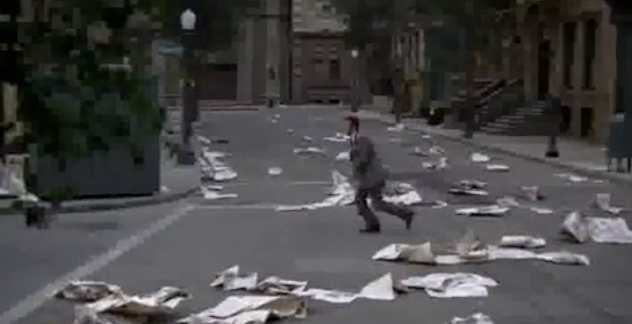
Kroll has just inadvertently given up the evidence, and suddenly everyone around him seems to evaporate.  Everyone has been pulled out, you see. One would also expect cops would be storming in, but go with it. Kroll wanders out into the period street, so bustling with life just moments prior, and it is now empty and abandoned. Kroll begins running, searching, and as he does so we see the ink put in his hair to shade it run down his cheeks. His wax begins to loosen. His limp returns. But he keeps running…until he runs all the way off the set and onto another one on the backlot: an street from classic shoot-‘em-up Westerns. It’s a wonderful, metaphorical image to end our story. Indeed, we don’t see Phelps apprehending our villain or even anything close to that. Instead, we see Kroll’s second in command, a man in his 60’s like Kroll, approach him – a reminder of who he really is and a mirror image Kroll does not want to look at. That is more of a defeat for him than being hauled off in handcuffs. And also, from the writing to direction, beautifully realized.

Back when I wrote about “Battlestar: Galactica” I noted how awesome it was that they share a sneak preview of what’s to come in the episode, and here I was just as excited to see the same in the opening credits. The show’s iconic theme music plays as we are shown tiny snapshots of exciting moments in the episode to come. Yes, setting Lalo Schifrin’s music against anything, even “Heaven’s Gate,” would make what we are seeing the most exciting action film ever made, and I think that’s the point. It jazzes up the viewer and ensures that he or she will be back and ready for more just as soon as the commercial break is over.

I’m surprised it’s taken me this long to watch the original “Mission: Impossible” television show. I’m a huge admirer of the film series, and now have set my DVR to tape the show’s nightly airing. From glancing at several articles, it appears that “Encore’s” craziness is the exception in the series, not the rule. But even if the show remains (relatively) grounded throughout the rest of its run, that won’t mean I love it any less. I can’t help but love the smoke-and-mirrors game it plays with its viewers and villains every week…and that theme song will never get old.

“Encore” is available on DVD and YouTube.


Tuesday, January 8, 2013

The X-Files - "The Post-Modern Prometheus"

Season 5, Episode 5
Original Airdate: November 30, 1997
Writer/Director: Chris Carter
Executive Producers: Chris Carter, R.W. Goodwin
Cast: David Duchovny, Gillian Anderson, John O’Hurley, Chris Owens

It’s impossible to choose a “best” episode of “The X-Files” because there are legitimately too many great ones to choose from. More than that, many of the great episodes are scary, some are funny, and others are fantastic mind games. Others are all of the above. Even masterworks like “The Sopranos” and “Seinfeld” have that one episode that can stand as a representation of everything the show can accomplish, but that’s not so with “The X-Files.” The stories, and voices of its writers, are just too varied to allow one hour to represent it. The only other show I can think of off the top of my head like that is “The Twilight Zone,” which puts this program in good company. I chose “The Post-Modern Prometheus” not because it is the show’s “best,” but it’s because it is my favorite.

Each episode would involve FBI Agents Mulder (David Duchovny) and Scully (Gillian Anderson) investigating the unexplainable. Mulder is a true believer in alien abduction, vampires, demons and the forces of evil. Scully, despite being proven wrong in almost every episode, continues to be cynical. The unexplainable occurrence here involves a version of the Frankenstein monster who breaks into women’s houses and inseminates them over the course of several days (he uses termite tents as a way to ensure he’s not caught). Oh, and he has a Cher fetish. Yes, that Cher. If you didn’t grin from ear to ear reading that summation, then there’s just no talking to you. Yes, this is one of the lighter “X-Files,” feeling much more like a fairy tale than a horror movie.

Writer/Director Chris Carter (also the show’s creator) chose to shoot in black-and-white as an homage to James Whale’s two Universal “Frankenstein” films. And indeed the skies are painted grey like in those films, and villagers with pitchforks serve a big purpose in the climax. But there are also numerous nods to Mary Shelley’s original novel, beginning with the name of the episode and in several lines of dialogue (yes, I know Mulder gives us the wrong ending to the novel…shut up!). Despite most of the episode’s characters being, uh, a few watts short of a working lightbulb and mainly obsessed with getting on “The Jerry Springer Show” (Springer has a cameo), the episode is one of the smartest of the series. Every time I revisit the show after a few months or years, I’m always pleasantly surprised by the intricacies of the dialogue, and how the writers never shy away from allowing their two protagonists to sound smart (really, really smart), even if some of the language goes over the heads of viewers. Big words are more and more of a “no-no” in today’s television landscape, and that’s such a shame because, looking back on the literacy of shows like “The X-Files” is almost like visiting a foreign planet (ugh, I’m so sorry for that pun, but not sorry enough to erase it).

The subject matter and the tone of “The Post-Modern Prometheus” prove just how versatile the series can be and what kinds of chances it was willing to take on a regular basis (I did mention the Cher fetish, right?). The black-and-white was a brilliant decision, and Joel Ransom’s work as cinematographer is absolutely sterling. The world is gorgeous to look at, and Gillian Anderson has never looked lovelier than here.

One thing that I don’t think “The X-Files” gets enough credit for is its inherent humanity. For a show that is, at its base, about scares and little green men, a lot of screentime and effort is taken to develop its one-off characters who may or may not survive ‘til the end of the hour. Similar horror shows treat them simply as monster bait, but here the writers genuinely attempt to make us care about these victims…and in the case of this episode, its monsters as well.  In the final act, the monster (Chris Owens, later to play Jeffrey Spender) gets a chance to explain his actions and the horrors he has apparently acted out to his “victims.” The scene is beautifully written and staged, but the kicker is what comes next. Carter ends the episode set to Cher’s cover of “Walking in Memphis,” with the monster actually getting to attend a Cher concert, where Cher (be still my heart) embraces him and takes him onstage with her. Totally unrealistic? Sure, but who cares? This is a fairy tale, and no one wants realism in one of those. Bonus points for letting Scully smile, which is something which doesn’t happen often enough in the show’s 202 episodes.

Yes, 202 episodes (plus two movies). It’s shocking how consistently great the show was during its entire run. The final few seasons got a lot of criticism while still airing for not being up to the standards of earlier episodes, but re-examining them today with fresh eyes reveals that the show remained great up until the very end. Episodes like “Roadrunners,” “Via Negativa,” “Daemonicus” and “Improbable” easily stand with the best “X-Files.”

“The Post-Modern Prometheus” just eeked its way past “Home,” “Triangle,” “Bad Blood” and the Darin Morgan installments to be the first “X-Files” episode I wrote about, though I’m sure several of the above will have their own columns soon. The fantastic thing that allowed “The X-Files” to last so long and work so well in different tones and genres was that it could be about anything just so long as it was something we, as human beings, cannot understand yet. Yes, that involved a lot of darkness, but it had a lot of hope as well. It is also one of the shows that made me want to be a writer.

“The Post-Modern Prometheus” is available on DVD, iTunes, Hulu Plus and Amazon Prime.